Your personal search profile
Receive the real estate offers you are looking for before they are even on the market.

Rent out
Date
6.4.2017
Share
Article as PDF (Author Boris Grell, TREX 2016/5)
1. facts and initial situation
It is not just the surprise, but also the bewilderment—and not infrequently the resentment—that are significant whenever a Property owner intending to build or sell is suddenly confronted with the news that the municipality has “listed” his house—and, in some cases, the associated garden as well, or perhaps only the garden—in whole or in part. The same situation can arise in the case of a community of heirs seeking to sell a listed property, or when an heir is to take over the property in question as part of the division of the estate. As a result, those affected often feel taken aback because the municipality never informed them of such “inventorying,” and the planned timeline and schedule for the construction project or the Sales of the property usually have to be redefined. In fact, this approach by the authorities is unfortunate; nevertheless, it is legally permissible, as the following explanations will show. At the same time, these explanations are also intended to provide some clarification in order to limit such surprises or, ideally, to avoid them entirely.
2. legal basis
In accordance with the Planning and Building Act of the Canton of Zurich (hereinafter referred to as “PBG”) a. Buildings and parts and appurtenances of buildings that are worthy of preservation as important witnesses of a political, economic, social or architectural epoch are inventoried. An inventory of valuable parks and gardens, trees, tree stands, copses and hedges is also possible (cf. § 203 para. 1 lit. b and lit. f PBG). The authorities responsible for protective measures draw up inventories of such protected objects, whereby the inventories are available for inspection at the municipal administration at the location of the object in question.
However, in the scenario described above, the properties concerned are not included in such a publicly accessible inventory, in which only those protected objects are listed that have been officially – i.e. definitively – protected as part of a so-called definitive protection measure. h. usually through a decree, an ordinance or a so-called administrative contract with the municipality – were included in the said inventory.
3. shadow inventory and its reasons
But what kind of inventory are we talking about? I deliberately call it a shadow inventory. This is because this inventory does not officially exist and usually only exists in the form of a federal folder in which the objects to be protected are filed with a more or less detailed brief description of their worthiness of protection. This very unsatisfactory circumstance is essentially and directly related to the also very unfortunate lack of notification by the municipal authority to the affected property owner mentioned at the beginning that his property (or parts thereof) had just been “provisionally inventoried”. According to § 209 para. 2 PBG triggers the written, d. h. official, official notification to the landowner about the inclusion of his property in the inventory not only prohibits actual changes to the designated object without the approval of the ordering authority, but also sets a one-year enforcement period in order to make a “permanent order” about the protected object. In other words, the prohibition of change lapses if the municipal authority has not taken a definitive protective measure within this one-year period since the aforementioned written notification about the affected property. If you take a look at the aforementioned federal file in the municipal chancellery with the buildings in it that are likely to be worthy of protection, it also becomes clear why the authorities cannot and do not have to inform the affected property owners about this “provisional inventory”. This is because each of these official notifications triggered a separate, one-year deadline for each of the properties included in the shadow inventory. Understandably, every municipal authority would probably be overburdened in terms of personnel, time and possibly also financially6 with the simultaneous examination of the definitive worthiness of protection of the individual properties, which usually has to be carried out in parallel with the involvement of experts.
4. what to do? – Provocation request
If a property owner—regardless of how —that their property is listed in the shadow inventory, or if they wish to obtain certainty regarding such a listing in connection with a construction project or the Sales of the property, their only option is to take the initiative in order to receive a definitive response to their inquiry.
Thus, pursuant to § 213 PBG, every property owner is entitled at any time to request a decision from the local government regarding whether their property is worthy of protection and the scope of any protective measures, provided they can demonstrate a current interest. To this end, it is sufficient, for example, if the landowner has specific construction plans or can credibly convince the municipal authority of an impending division of an estate or the Sales of the property that may be affected by the inventory.
Such a provocation request must be submitted in writing to the municipal council. The responsible local authority will then make a decision within one year at the latest, although in exceptional cases it may notify the landowner before the deadline expires that the treatment period will be extended by a maximum of one further year. In this time frame, the authority clarifies whether the property covered by the provocation request is even included in the shadow inventory and – in the case of inventorying – whether or not full or partial protection is appropriate.
If the municipality comes to the conclusion (for whatever reason) that protection should not be granted, this decision is formally communicated to the landowner concerned. Likewise, the protection status as well as the contrary, formal waiver of a protection status – as well as the mere unused expiry of the forfeiture period by the authority pursuant to § 213 para. 3 PBG – be published in the official publication organs. Furthermore, the relevant decision files must be available to the public during the 30-day appeal period so that the property owner affected by an inventory, as well as third parties (in particular nature and heritage conservation organizations and neighbors in the event that an inventory is not carried out), can appeal the municipality’s decision to the building appeals court. In any case, the provocation request triggers an official and possibly also judicial investigation procedure, which inevitably takes time and money, whereby a duration of at least one year must be expected as a rule. As an alternative to the provocation request and if all parties involved agree on the scope of protection, an administrative protection agreement can also be concluded with the competent authority within a shorter period of time.
5. summary and recommendations
Shadow inventories created by the municipality are not only a nuisance for the property owners affected, but can also significantly delay, increase the cost of, or even prevent a construction project, the division of an estate, or Sales.
If a landowner intends to enter into such Real estate transactions, the following recommendations should be observed:
As a result, an authority or a court decision according to which the municipality either:
* Author of the article: Dr. iur. Boris Grell, LL.M., Certified Specialist SBA Construction and Real estate Law, Legal Advisor to the Swiss Chamber of Real Estate Agents, Zurich, www.maklerkammer.ch

NZZ Residence, October 26: Interview with Claude Ginesta: “To me, providers of fixed-price models aren’t real Real estate agents”
Reading time: 8 min

World Habitat Day
Reading time: 5 min

Event: Real estate Gains Tax on the Sales of a Multi-Family Home
Reading time: 1 min
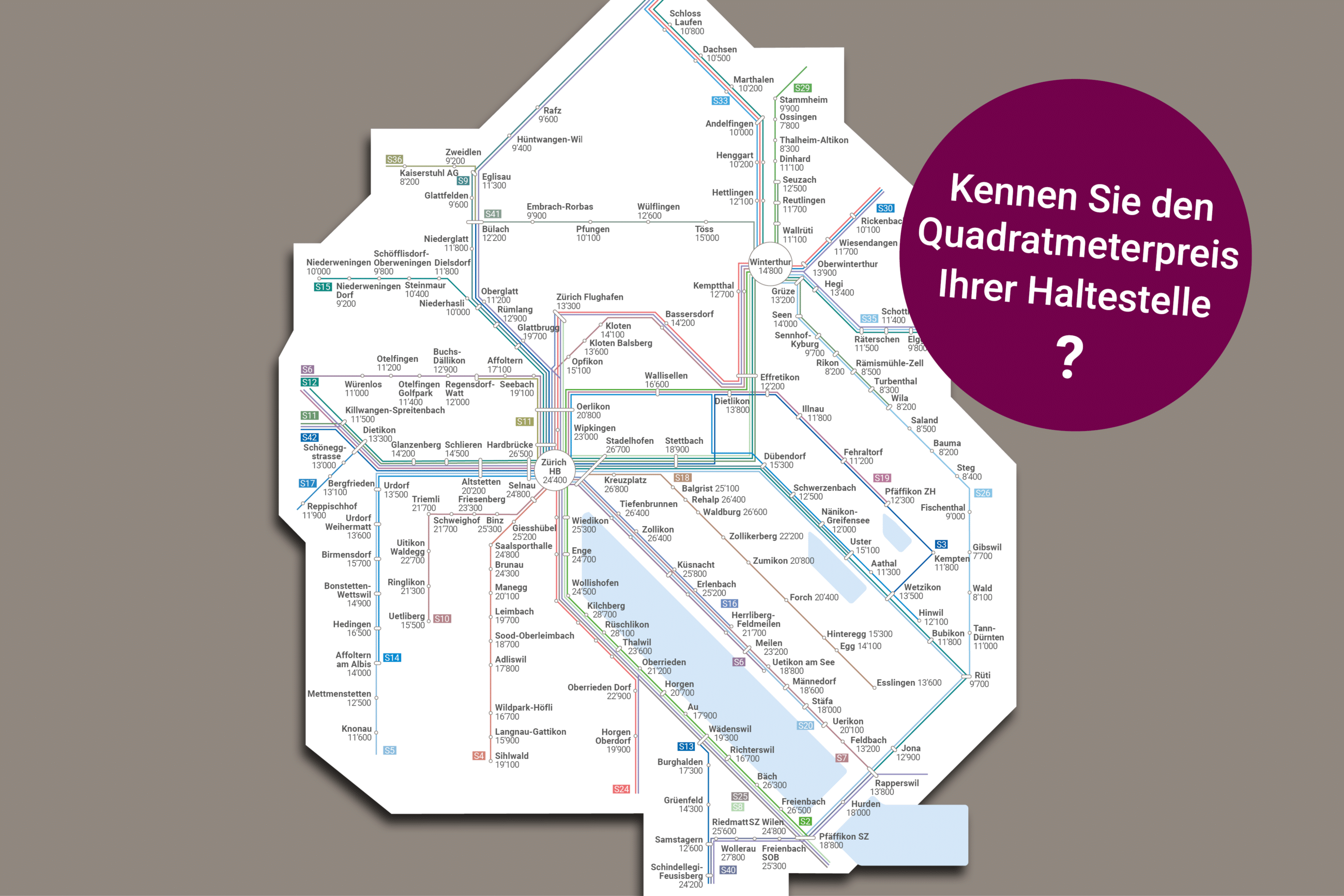
The real estate market is riding the S-Bahn
Reading time: 2 min