Your personal search profile
Receive the real estate offers you are looking for before they are even on the market.

Rent out
Date
2.10.2026
Share
Most people in Switzerland Rent their homes: In 2024, approximately 2.48 million households lived in rental or cooperative apartments. About 1.45 million lived in their own house or apartment. At the end of 2025, Switzerland had a total of about 4.88 million apartments and over one million single-family homes. This figure also includes unoccupied properties and second homes. These are the figures from the Federal Statistical Office that paint a picture of Switzerland’s housing landscape .
In 2025, an occupied apartment had an average living area of 102 square meters. On average, 46.6 square meters were available per person. This figure had been rising for many years but has stagnated since 2021. Regional differences are striking: In the Lake Geneva region, Living space per person was 42.5 square meters; in Eastern Switzerland, 49.7 square meters; and in Ticino, 49.8 square meters. Single-family homes offer more space per person. It is striking that 55 percent of occupied single-family homes were inhabited by only one or two people. Single-family homes thus often serve small households. A former children’s room can now serve as a home office, a guest room, or a quiet retreat. Extra space can be useful, even when fewer people live under one roof.

Source: Federal Statistical Office.
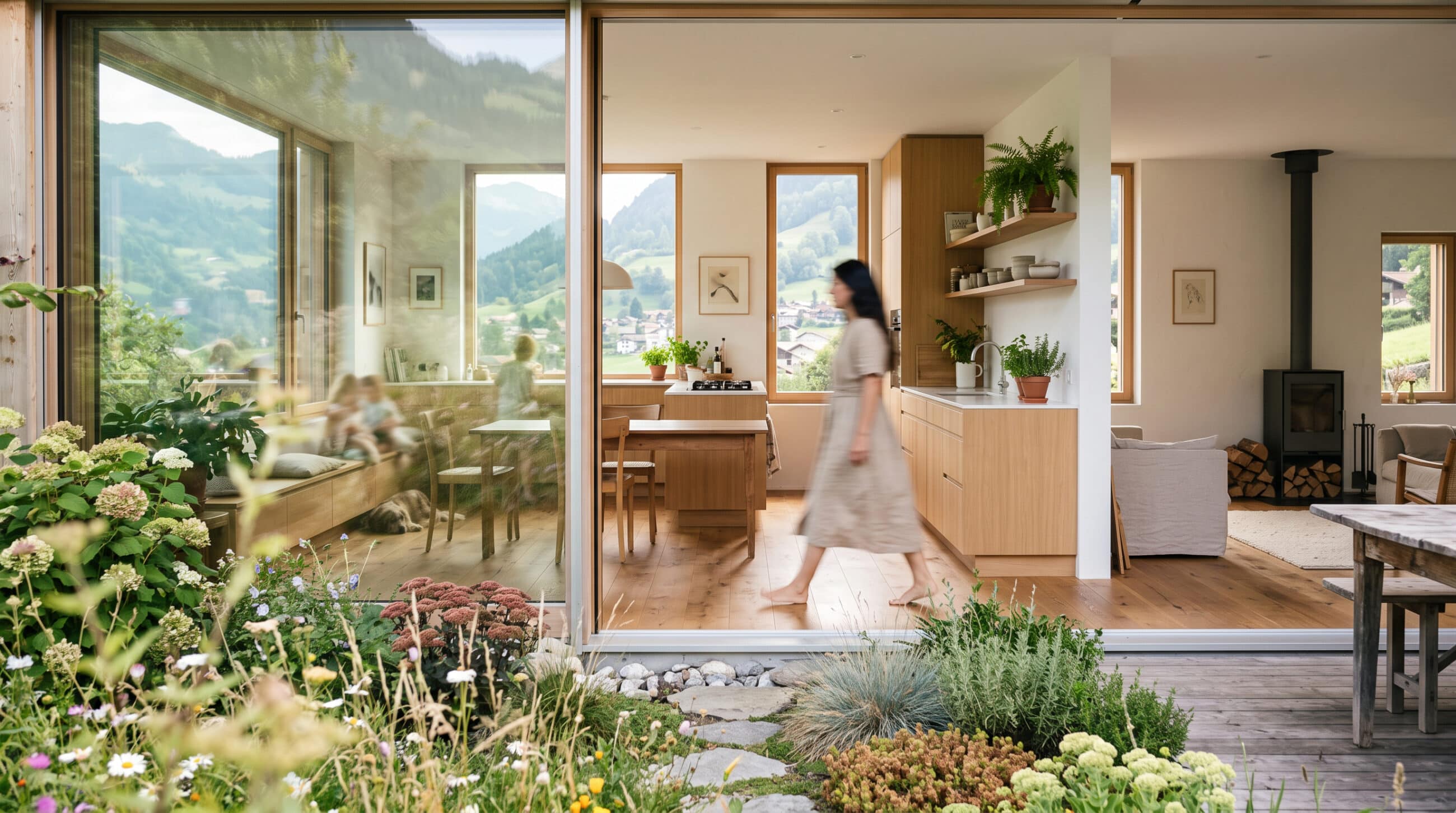
However, how well a home suits one’s lifestyle does not depend solely on its size. For many people, owning a house with a yard is associated with a desire for peace and quiet, nature, and the freedom to live life on their own terms.
At the same time, everyday life should remain uncomplicated. Good public transportation access, convenient shopping options, and short commutes to school, work, or friends play an important role in choosing where to live. Those who want to live in a green setting therefore often look for good connections to the places and people that shape their daily lives.
These needs are not always compatible with one another. Proximity to the workplace, familiar people, and a well-developed infrastructure keep many people tied to the city or Metropolitan Area. Thus, the desire for rural living may persist, while daily life continues to revolve around urban centers. The actual trend can therefore be described less as rural exodus and more as progressive urbanization.
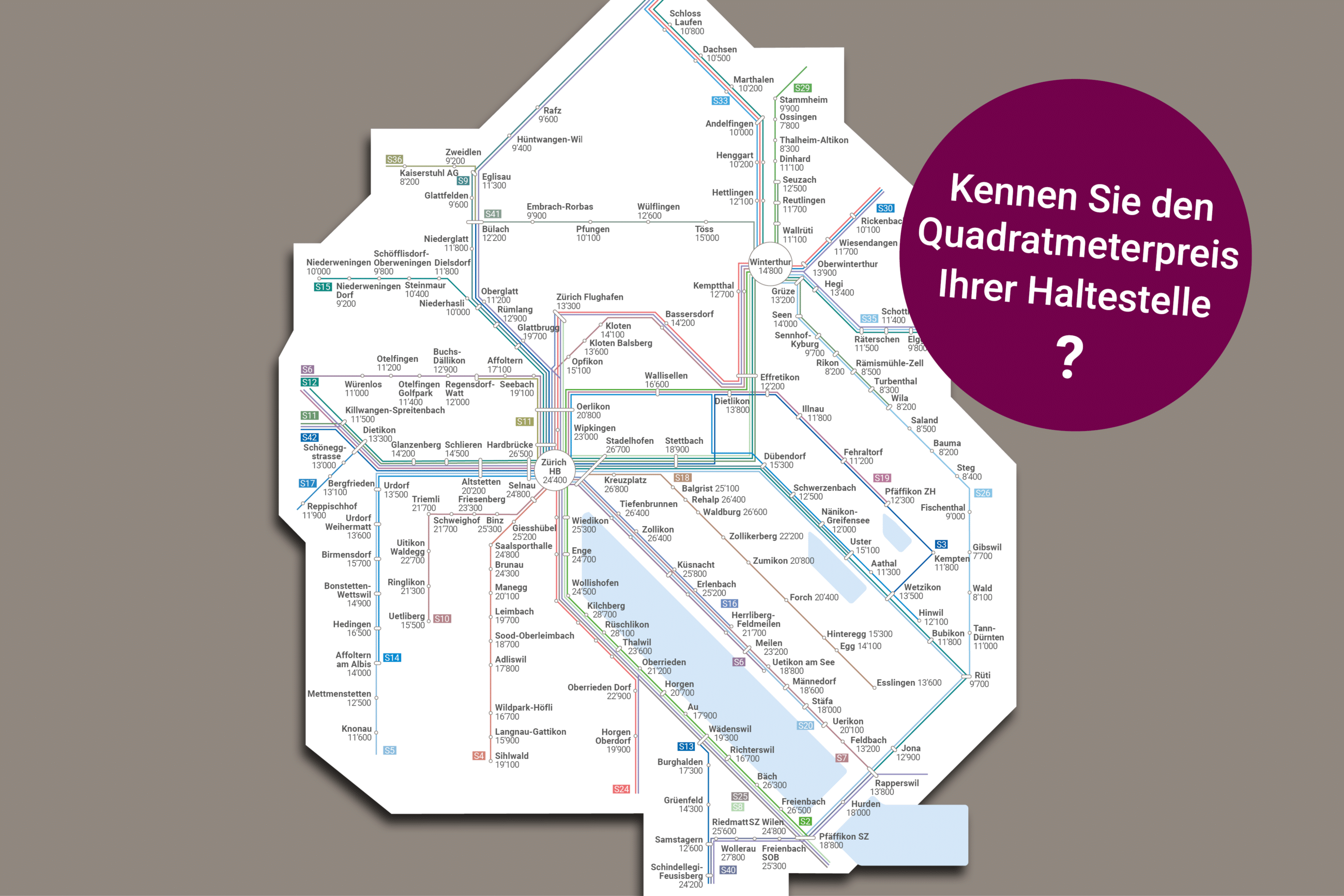
However, there are many options between living in the city center and a secluded house in the countryside. Our somewhat different approach shows just how much Real estate prices can vary even within a single region. ZVV S-Bahn Route Map for Single-Family Homes and Condominiums. A train ride of just a few minutes can make a difference of several thousand francs per square meter. Municipalities that haven’t been considered in the search so far may therefore be worth a closer look. A longer commute can be a conscious compromise. Those willing to commute farther each day may find a suitable home elsewhere at a lower price. This applies to the canton of Zurich as well as to other regions of Switzerland.
However, expanding the search radius does not automatically lead to a move. The ZHAW study “Rethinking Residential Mobility” from 2025 examines why people often do not move. It concludes a series of studies conducted in collaboration with the Federal Office for Housing, the Swiss Homeowners’ Association, and the Fédération Romande Immobilière.
For younger people, the desire to own a home is often countered by high Real estate prices, limited supply, and stringent financing requirements. In later stages of life, a different question arises: Is it worth giving up a familiar living situation?
This issue becomes particularly relevant after children move out or upon retirement. Research from the ZHAW shows that some people between the ages of 45 and 79 live in housing situations that no longer meet their needs. While there is a desire for change, suitable options are often lacking.
A smaller home may mean lower Maintenance costs. A more central location can make daily commutes easier. At the same time, your current home is filled with memories, familiar neighbors, and habits that have developed over the years. These considerations are just as much a part of the decision to move as square footage and price.
Those who explore their options early on can plan for changes without immediate time pressure. In addition to traditional apartments or single-family homes, multigenerational homes, shared living arrangements for adults, and service-based apartments offer further options. Depending on one’s stage of life, these options can provide more community, support with daily life, or less work managing one’s own household.
The concerns of individual households also shape the demands placed on the housing supply. The future of housing in Switzerland is shaped by a growing number of small households and an aging population. There is a demand for housing that suits different stages of life: well-connected, as barrier-free as possible, and with manageable Maintenance costs.
At the same time, existing buildings offer potential—for example, through renovations, the addition of new residential units, or repurposing.
World Habitat Day is an opportunity to consciously reflect on one’s own living situation: What should a home provide today, and what will be important in the future?

Contact Ginesta Now
"*" indicates required fields

NZZ Residence, October 26: Interview with Claude Ginesta: “To me, providers of fixed-price models aren’t real Real estate agents”
Reading time: 8 min
Event: Real estate Gains Tax on the Sales of a Multi-Family Home
Reading time: 1 min
The real estate market is riding the S-Bahn
Reading time: 2 min

With “IN PASSING,” Claude Ginesta reveals a side of himself that few know.
Reading time: 3 min