Your personal search profile
Receive the real estate offers you are looking for before they are even on the market.

Rent out

Date
5.7.2026
Share
The situation is often similar: The heating system is reaching the end of its life cycle, the Roof and facade are in need of renovation, the building services no longer meet current standards, and rents are in some cases significantly below market levels. At the same time, demand for housing remains high in many regions. In the canton of Zurich, the vacancy rate stood at just 0.48 percent in mid-2025, and in the city of Zurich it was as low as around 0.1 percent. Well-located apartment buildings thus remain sought-after investment properties.
The greatest value often lies where owners least expect it
In practice, discussions often start with heating systems, facades, or bathrooms. Strategically, however, a different question is crucial: What value can the Property generate in the future?
In addition to the structural condition, the following factors in particular should therefore be analyzed:
Particularly in the case of apartment buildings from the 1950s through the 1970s, a significant portion of their value lies not in the building itself, but in the land and its Development potential. Anyone who fails to take this aspect into account risks making substantial investments in a plan that does not fully realize the property’s true potential.
A forward-looking strategy creates long-term value
Many homeowners initially wonder whether they can afford a Renovation. The more important question, however, is: Which option will create the greatest long-term value?
To this end, various scenarios should be systematically compared based on the factors mentioned above:
Only when investment needs, Financing, rental potential, tax implications, net sales proceeds, and development potential are considered together can a sound basis for decision-making be established. Professional investors do not make such decisions based on individual construction cost items, but rather on the expected return, risk, and long-term value appreciation.
Looking at Renovations from an Economic Perspective: Not Every Franc Invested Is Recouped
A common misconception is to equate investment costs directly with future rent increases. Swiss rental law sets clear limits in this regard. A significant portion of comprehensive renovations is considered to preserve value and cannot be passed on entirely to tenants. At the same time, location, demand, and the current rent level determine what return potential can actually be realized.
The technical feasibility of a renovation is therefore only one side of the coin. Equally important is the question of whether the investment will Yield the desired return under the current framework of rental law.
Financing Becomes a Key Factor
In addition to economic efficiency, financing is increasingly becoming a focus. While many owners have substantial assets, they do not necessarily have the liquidity required for major investments.
Banks now scrutinize renovation projects much more closely than they did a few years ago. In addition to financial viability, the Equity ratio, ability to recoup costs, and the long-term value retention of the investment play an important role. Therefore, it is important to determine early on whether the planned measures are financially viable and how they will affect future returns.
Energy efficiency is becoming a strategic factor
A large portion of Switzerland’s residential Building stock was constructed before the first comprehensive thermal insulation regulations were enacted. Consequently, there is a significant need to upgrade heating systems, building envelopes, and building services. With cantonal energy laws and regulatory requirements, these standards continue to rise. At the same time, tenants are paying increasing attention to utility costs, and investors are placing greater emphasis on sustainability criteria.
For property owners, this means that not every energy-efficiency investment automatically adds value. The key factor is whether the measures will strengthen the property’s competitiveness in the long term and help avoid future investments. Incentive programs can improve the cost-effectiveness of individual measures, but they are no substitute for a well-thought-out overall strategy.
The issue of succession is often underestimated
One aspect that is often not discussed until later in practice is succession. Who will own and manage the property in ten or fifteen years?
This question often determines the right strategy, particularly in the case of family-owned properties and communities of heirs. A comprehensive renovation can make economic sense. However, if there is no clear succession plan or if there are conflicting interests among the owners, the situation changes fundamentally. Issues related to ownership, inheritance, and succession should therefore be incorporated into strategic considerations at an early stage.
When Sales May Be the More Economically Sensible Solution
Sales may be the right solution if the owners no longer wish to shoulder the burdens associated with a renovation themselves, the complexity is too great, and the financial and time commitments seem overwhelming. In practice, this often applies to communities of heirs with differing views on the property’s future or to owners who no longer wish to actively deal with complex construction, financing, and management issues. A lack of liquidity or insufficient equity can also be factors against a comprehensive renovation. Last but not least, the time commitment and business risks of a renovation or development project should be realistically assessed.
Sales are therefore not necessarily an indication that the property lacks potential; rather, they can be an economically sound decision if personal, financial, tax, or organizational circumstances make long-term development unfeasible.
Not every group of buyers evaluates a property in the same way
The Market value of a multi-family home does not depend solely on the condition of the building. Different groups of buyers may assess the same property in very different ways.
While long-term property owners focus primarily on income, returns, and management costs, developers also evaluate potential for densification, opportunities for new construction, and the future use of the property.
This can lead to significant differences in willingness to pay, particularly in older apartment buildings.
For property owners, therefore, it is not only important to know what the property is worth today, but also which market participants can benefit from its development potential. A professional Real estate appraisal based on verifiable figures can provide insight into this.
Conclusion: Guidance for Making an Informed Decision
The question of “renovate or sell” cannot be answered based solely on the condition of the building.
Anyone who wants to make a sound decision should systematically analyze five areas:
Only when these factors are considered together does a complete picture emerge, thereby providing a solid basis for decision-making. It is crucial to identify the existing potential and use it to develop the most economically sound strategy for the coming decades.
Our apartment building assessment reveals your property’s potential—and provides a solid foundation for deciding whether to renovate, develop, or sell.
Our expertise in this area guarantees a thorough analysis of your property, from identifying opportunities for optimization to providing an initial technical assessment.
We offer this check-up for apartment buildings with up to ten units free of charge. For larger properties, we’d be happy to provide a customized quote.

NZZ Residence, October 26: Interview with Claude Ginesta: “To me, providers of fixed-price models aren’t real Real estate agents”
Reading time: 8 min
World Habitat Day
Reading time: 5 min
Event: Real estate Gains Tax on the Sales of a Multi-Family Home
Reading time: 1 min
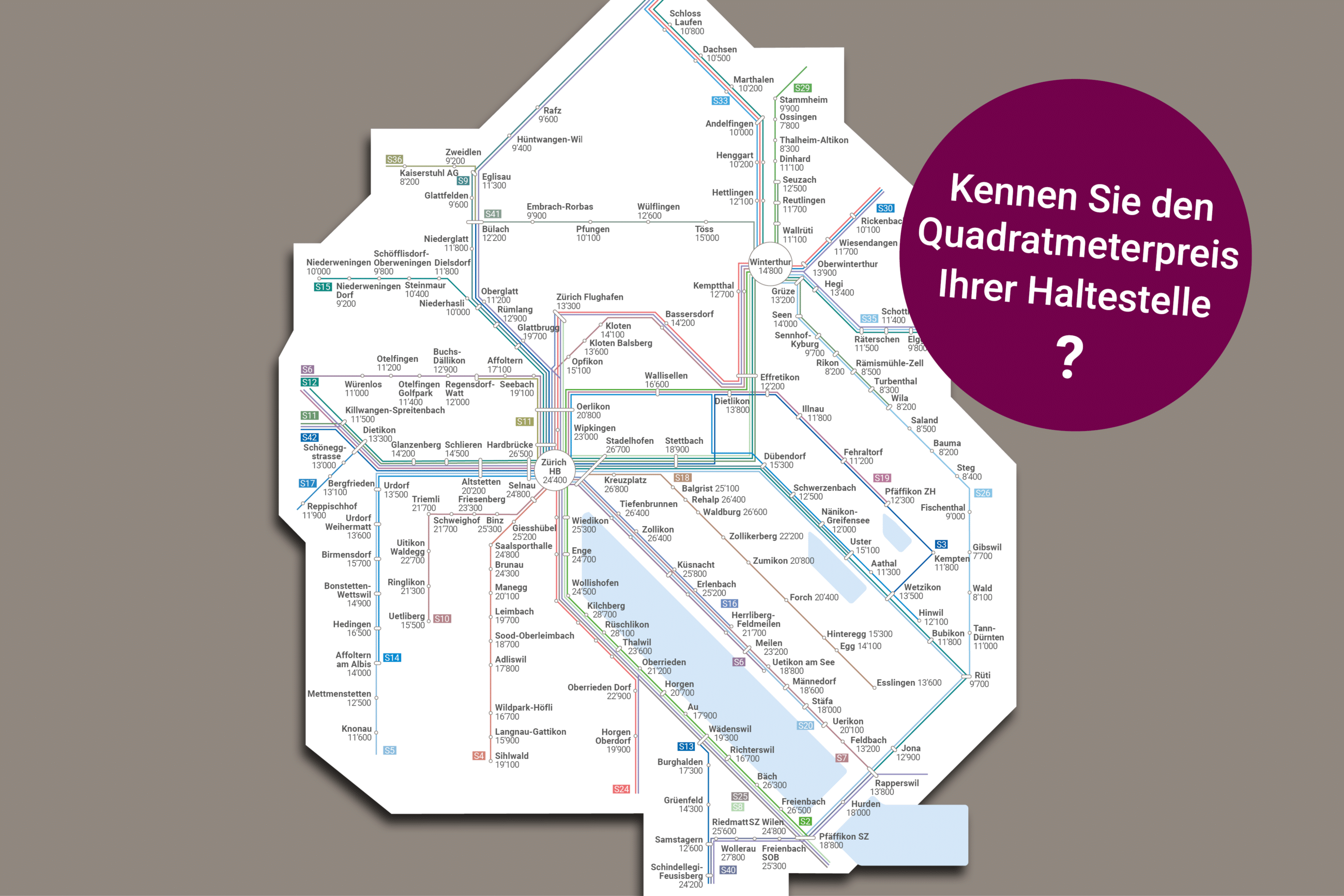
The real estate market is riding the S-Bahn
Reading time: 2 min