Your personal search profile
Receive the real estate offers you are looking for before they are even on the market.
Rent out

Date
9.1.2023
Share
Let’s start with a brief overview of which types of tax are levied and by whom:
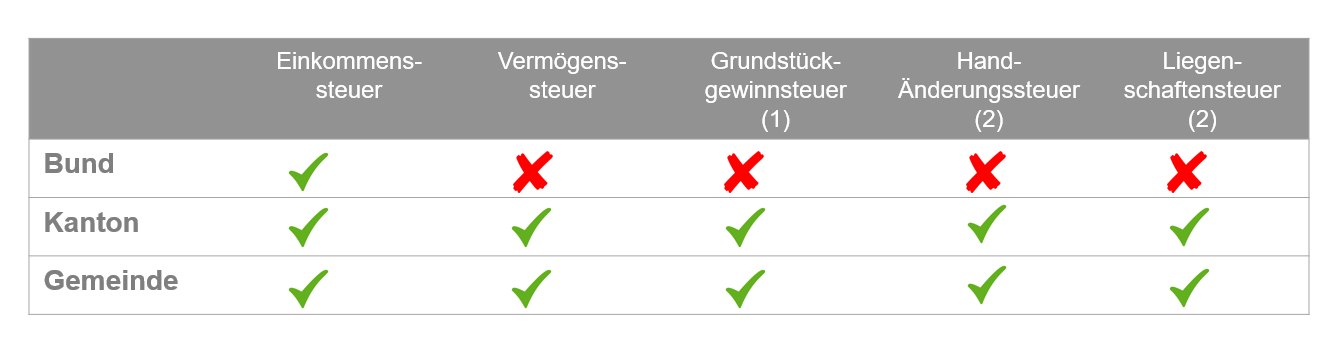
1. Property gains tax is usually levied by the cantons, in some cases also by the communes and in the cantons of Zurich and Zug only by the communes.
2. these two taxes are handled very differently and there are even cantons such as Zurich where they are not applied at all.
The income tax
Taxes are levied by the federal government, cantons and municipalities on income from privately owned properties. Rental income and, in the case of owner-occupied properties, the imputed rental value are deemed to be income, as the owner does not earn any taxable income, unlike in the case of a rental. In return, maintenance and financing costs can be deducted, but not value-enhancing expenses
The Wealth tax
The tax levied at cantonal and municipal level covers properties held as private assets less debts.
Property gains tax
Tax is levied on a realized gain at the time of Sales. This tax is collected at the cantonal level, but in most cases, the municipalities assess this cantonal tax, which they may also retain. Accordingly, this tax revenue is not taken into account for intercantonal tax equalization. This tax provides for various grounds for tax deferral, such as the replacement of the asset, inheritance, or the division of marital property.
The transfer tax
If a property changes hands, this transaction-based tax may apply. This sometimes varies greatly between the individual cantons. The highest known transfer taxes are levied in Basel-Stadt, Geneva and the canton of Neuchâtel at three percent. Zurich, Uri, Zug, Glarus, Schaffhausen and Schwyz do not levy this tax. Every canton that levies this tax recognizes tax-exempt or tax-privileged changes of ownership such as replacement purchases, an inheritance or a property settlement. The handling of these exemptions is also very different in some cases.
The Property tax
This tax on the holding of a property is levied annually in very few cantons, but in all municipalities on the basis of the full Market value without deduction of debts. Many cantons, such as Zurich, Zug and Schwyz, do not levy this tax.
Last but not least: value added tax
As a general rule, Real estate used for private purposes is not subject to value-added tax (VAT) during sales or rentals. Accordingly, no input tax credit can be claimed on investment, operating, and administrative costs. But there are no rules without exceptions …
The first is: If a property sale of a new building takes place before the start of construction, this constitutes a taxable Real estate supply and VAT is payable.
The second provision states that if a property is used for commercial purposes by a buyer or tenant who is subject to Value-added tax, the Sales or lease may be voluntarily subject to value-added tax. Anyone interested in learning more about this option—which can lead to significant cost savings in some cases—is advised to seek expert advice from a tax specialist.
Anyone who does not live in a property themselves and is registered in another canton or owns a vacation property in Graubünden or Ticino, for example, is well advised to look into the situation before making a purchase in order to avoid any double taxation.
In principle, real estate is taxed at the place where it is located. In contrast, however, you base your unlimited tax liability on your place of residence. The result is a tax differentiation between the two cantons, which can quickly become a confusing matter in detail.
Ideally, you should consult a professional; when dealing with Sales through Ginesta Real Estate, your personal real estate advisor is available to assist you.
This chapter deals with the most frequently asked questions on the subject of when to expect which taxes.
Ownership and use
The Market Value of the property is subject to property taxation. Income as well as the imputed rental value as notional income are subject to income taxation after the corresponding deductions and are payable where the property is located. Value-enhancing investments are not deductible, but maintenance work is. Be sure to read the section on “Building and conversion”.
Imputed rental value
This is somewhat lower than the value that can be achieved through effective letting at market prices and is calculated or estimated by the cantonal tax authorities. The imputed rental value also applies to domestic vacation properties.
Sales
Profits and losses are tax-free at federal level, while property gains tax is payable at cantonal level.
Purchase
The purchase in and of itself has no direct tax consequences apart from the transfer tax. The same applies if the property was obtained through an exchange, gift, inheritance or change of ownership between spouses.
Inheritance and giving
If you acquire a property in this way, the applicable real estate gains tax is deferred. This is a deferred liability that must be settled in the event of subsequent Sales.
Building and remodeling
During the construction period—that is, while a new building is being built—the imputed rental value is not taxable, and the construction costs can only be claimed upon the sale of the property. Anyone who performs significant work on the property themselves during construction should definitely discuss tax and social security issues with a specialist.
Anyone who renovates or refurbishes a property must classify their expenses as either Maintenance-related or value-enhancing investments. Maintenance expenses may be deducted in the relevant tax year in the form of actual and verifiable costs or, optionally, as a lump sum. Value-enhancing investments, on the other hand, are not recognized as capital costs until Sales occur, provided that the increase in value is relevant for real estate gains tax purposes.
Expenses of a mixed nature, such as the installation of a luxurious eat-in kitchen with all conceivable appliances in the now open-plan living and dining area, where previously there was a shabby and no longer functional mini-kitchen in the better réduit, are to be divided into value-enhancing and value-preserving expenses.
If larger investments are required, it is advisable for tax reasons to consider staggering the work over several years or spreading it over two years.
Maintenance costs
As mentioned above, value-preserving maintenance costs such as insurance premiums, administration and repair costs can be deducted. In the case of owner-occupied properties, electricity, water, janitor costs and the like are of course not included in these maintenance costs and are therefore not deductible.
Debt and interest on debt
Debts and mortgages can be deducted from taxable assets without an upper limit.
Debt and Mortgage interest is deductible up to an upper limit of fifty thousand francs plus investment income.
Interest on building loans cannot be deducted for federal tax purposes, as these constitute investment costs. This is handled differently at cantonal level, sometimes as income-reducing expenses, sometimes as investment costs.
Tax value
The value of a property is part of the total net assets and is taxable at cantonal level, although the principles are not uniform in all cantons.

NZZ Residence, October 26: Interview with Claude Ginesta: “To me, providers of fixed-price models aren’t real Real estate agents”
Reading time: 8 min

World Habitat Day
Reading time: 5 min
Event: Real estate Gains Tax on the Sales of a Multi-Family Home
Reading time: 1 min
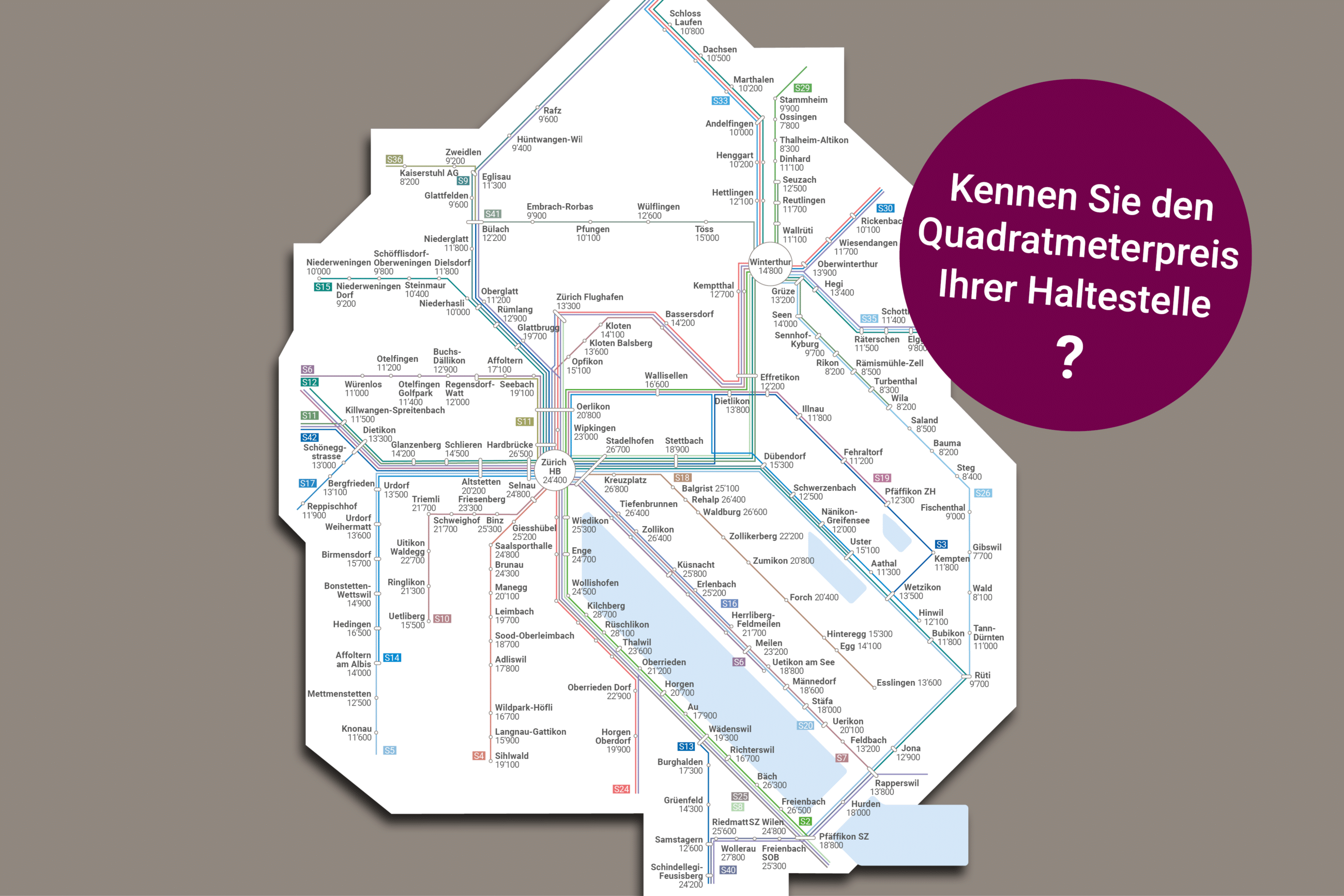
The real estate market is riding the S-Bahn
Reading time: 2 min