Your personal search profile
Receive the real estate offers you are looking for before they are even on the market.

Rent out
Date
18.3.2017
Share
The decision had actually already been made. But Thomas Rüegg pulled the emergency brake. The 38-year-old business economist vetoed the establishment of a Baumann Springs production site in India, a market worth billions. And this shortly after taking office as CEO of the family-owned company, which manufactures springs and stamped parts for the automotive, electrical and medical industries in Ermenswil in the canton of St. Gallen. His father, Hans Rüegg, who had previously been the head of the company for 27 years, had initiated the project.
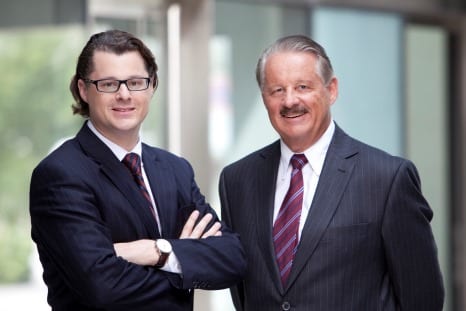
When the son decided to put his entry into India on hold for the time being, daddy was in Asia – and was anything but pleased when he heard about the U-turn. “He was quite angry,” recalls Thomas Rüegg. His father doesn’t deny this: “It makes a huge difference whether you can make the decisions yourself or not. I had to learn that first.” In two years’ time, Hans Rüegg (68) will also relinquish his position as Chairman of the Board of Directors at Baumann Springs and probably also his 30 percent mandate as an engineer, which he still holds in his own company. Then the fifth generation of the family will be at work alone.
Willy Michel (67) has also made a clear ship with his son. The founder of the listed medical technology company Ypsomed in Burgdorf handed over the management of the company to his eldest son Simon last July and limited himself to his role as Chairman of the Board of Directors and Delegate.
The takeover had been under consideration since 2006. However, Richard Fritschi, a non-family member, had to be temporarily installed as CEO. “Nothing is worse than a father who holds the reins and only realizes at the age of 70 that it might be time to ask his son to take over,” says the charismatic Willy Michel, who built Ypsomed into a global company with 1,100 employees and a turnover of almost 280 million Swiss francs. He did not have a plan B for the succession. “But of course I would have had to accept a no.”
And there are indeed more and more naysayers when companies are to be handed over to their children. According to a recent study by Bisnode D&B, almost 64,000 SMEs in Switzerland have a succession problem – in other words, it is still unclear who will run the company one day.
Patchwork constellations, an ambivalent younger generation with a high level of education, a multi-option society and – last but not least – a tougher economic environment are making it increasingly difficult to leave the company in the hands of the family. Or the interests of the next generation diverge – Sika sends its regards. “I could also have imagined a career in the telecommunications industry,” says Simon Michel, the new CEO of Ypsomed. When his father approached him on the subject of succession, Simon was on his way to Paris, where he could have set up UMTS in several countries for Orange. A tempting alternative.
A study conducted by the University of St. Gallen in collaboration with the consulting giant Ernst & Young also shows that young people no longer want to dedicate their careers a priori to their family legacy. Under the title “Coming home or breaking free”, students from 26 countries with a family business in the background were asked about their intentions. The result: just 6.9 percent wanted to join their parents’ company directly after graduating, compared to 12.8 percent five years later. In Switzerland, only three percent of those surveyed wanted to join their parents’ business straight after graduation – a reflection of a privileged labor market.
“In developing countries we can observe the phenomenon of succession compulsion, while in highly developed countries we speak of succession opportunity,” write the authors of the study. In the succession index, which they designed according to various criteria, Switzerland ranks at the bottom (see chart “The family business can wait”, page 60). In plain language: the Swiss can afford to pick and choose.
Sons in particular, who are still confronted with higher expectations from their fathers, like to play coy. Parents do have a say when it comes to their offspring’s career decisions. In the HSG survey, almost 85 percent of respondents stated that the opinion of parents was very important to them. However, demarcation is an important issue for same-sex successors. Sons like to consciously gain experience outside of their father’s realm – and do well to do so.
Thomas Rüegg, for example, opted for the complete contrast, working as a catering entrepreneur for several years after graduating from the University of Zurich and running trendy clubs such as Amber and Jade in Zurich. Today, he completes the disciplined daily program of a classic industry representative who is currently struggling with the consequences of the strong franc. What has remained is his “people-oriented”, team-based management style, with which he consciously wants to distinguish himself from his father, who was more of a patronage manager. “For me, it wasn’t a foregone conclusion that I wanted to do this job and that I could do it,” says Rüegg. It was only when he successfully revamped a plant in Italy for Baumann Springs that the economist realized that his place could be in the family business after all. One thing is clear: the father wanted him there. “I was certainly more loaded with expectations than his mother,” admits dad Hans Rüegg.
He is not alone in this. Even if cases such as Christoph Blocher’s Ems-Chemie, where Magdalena Martullo-Blocher successfully takes the reins, show that daughters are just as valid successors: The father-son constellation is by far the most common – and it harbors explosive material. “Daughters have it easier. They don’t have to deal with a father-son conflict,” says Heinrich Christen, Partner and Head of the Family Business Center at Ernst & Young.
The problem with this combination: “The son has to be good, but he can’t be too good. Otherwise the father will quickly have a problem,” says Christen. Continuing the tradition, emulating the father’s example: These are still important motives for successors. On the other hand, there is the desire for self-realization and the fear of being tied down forever and having to bear responsibility. When handing over from the founder to the second generation, two worlds often come together: the father has built up the business as a self-made man and managed it as a “gut man” – the son takes over the job as CEO with a university degree in his pocket and pushes the strategic approach.
According to Christen, the potential for a crash is greatest when founders hand over the company. “The patron wants a likeness, but this can also be a threat,” says Ladina Schmidt, Deputy Center Director of the Institute of Applied Psychology at the ZHAW University of Applied Sciences. If sons can prove themselves on the free market before the takeover, they gain self-confidence – a must for later cooperation with their father.
“Proving myself elsewhere was very important to me,” says Michael Sieber. The 37-year-old completed a logistics apprenticeship and a master’s degree in logistics management. His brother Christian (40), with whom he has managed the family-owned Sieber Transport AG in the canton of St. Gallen since 2011, gained experience in a consulting company after studying economics at the University of Applied Sciences.
As Chairman of the Board of Directors, the father is still a sparring partner. “Of course, we get in touch when necessary and ask for advice.” The Rüeggs also work hand in hand – although they are very different in terms of character and education: Father Hans comes from the engineering side, while his son is an economist. “Despite the noticeable contrast between my son and I, we complement each other perfectly and have a shared vision – we want to drive the Baumann Group forward in the long term,” says Hans Rüegg.
Things are not always so harmonious. Consultant Heinrich Christen is often called in when things are already getting out of hand and SMEs are in a tailspin because the handover is in danger of failing. “Company founders in particular often fail to build meaningful, fulfilling lives,” he says. The trend towards patchwork families also makes it more difficult to pass on the family legacy. Take Bindella, for example: When catering entrepreneur Rudi Bindella brought his second wife, Barbla Bindella (from whom he is now separated), into the management of the company, the second eldest of four sons, Adrian, who was already in the starting blocks, withdrew.
Leaving space, gaining distance: Not all fathers find this easy. “If the father remains omnipresent after the withdrawal, then this does not help the detachment process at all,” says Heinrich Christen. For the family expert, it is clear that symbolic gestures are essential to make the handover a successful maneuver. Company parking lot in the front row, the boss’s office: Things to be handed over to the son. And more importantly: “The father must hand over the shares to his son so that ownership is clear.”
The Ginesta family has stuck to this script. Claude Ginesta has been CEO of the Zurich Real Estate agent, which has branches in Küsnacht, Horgen and Chur and now employs 20 people, since 2006. 80 percent of the shares are already in his possession. “That was extremely important to me,” says the 42-year-old HWV graduate, who earned his spurs at McKinsey and VZ VermögensZentrum before joining the family business.
However, the handover of the papers did not go off without a hitch; the young Ginesta had to put the pressure on. “I really wanted a timetable for the share transfer. I really stressed my father out about it,” says Claude Ginesta, who remembers well how often he overheard his parents talking about the business as a child. “He can be very stubborn and knows exactly what he wants,” says father André Ginesta. The son also had to help a little with the official enthronement as CEO. “I actually gave myself this title.”
He is now the third generation of his family to run the company – and is about to set a decisive strategic course. The brokerage business is in a state of upheaval, Ginesta Immobilien is at a critical size and in the wake of digitalization. “We need to think about partnerships, but also about changing the business model,” says Claude Ginesta. His father, who lives in the office next door to him in Küsnacht, still has a say as Chairman of the Board of Directors. Appearances before the committee are no walk in the park. Only recently, Claude Ginesta’s proposal for new employee regulations failed.
Corporate governance works because a basic rule for the smooth running of the family business has been adhered to: appoint non-family members to the Board of Directors. Ex-Migros boss Anton Scherrer ensures that the critical distance to the CEO is maintained on the board. However, this can sometimes lead to strange situations. As father André Ginesta is still acquiring orders for the company thanks to his network of contacts, his son now has to decide on a bonus. Claude Ginesta remembers the time when it was the other way around: “When I joined the company at the age of 29, it was my father who decided the amount of my bonus. I found that somehow humiliating at the time.”
* This is a transcript of the balance sheet article published in May 2015.
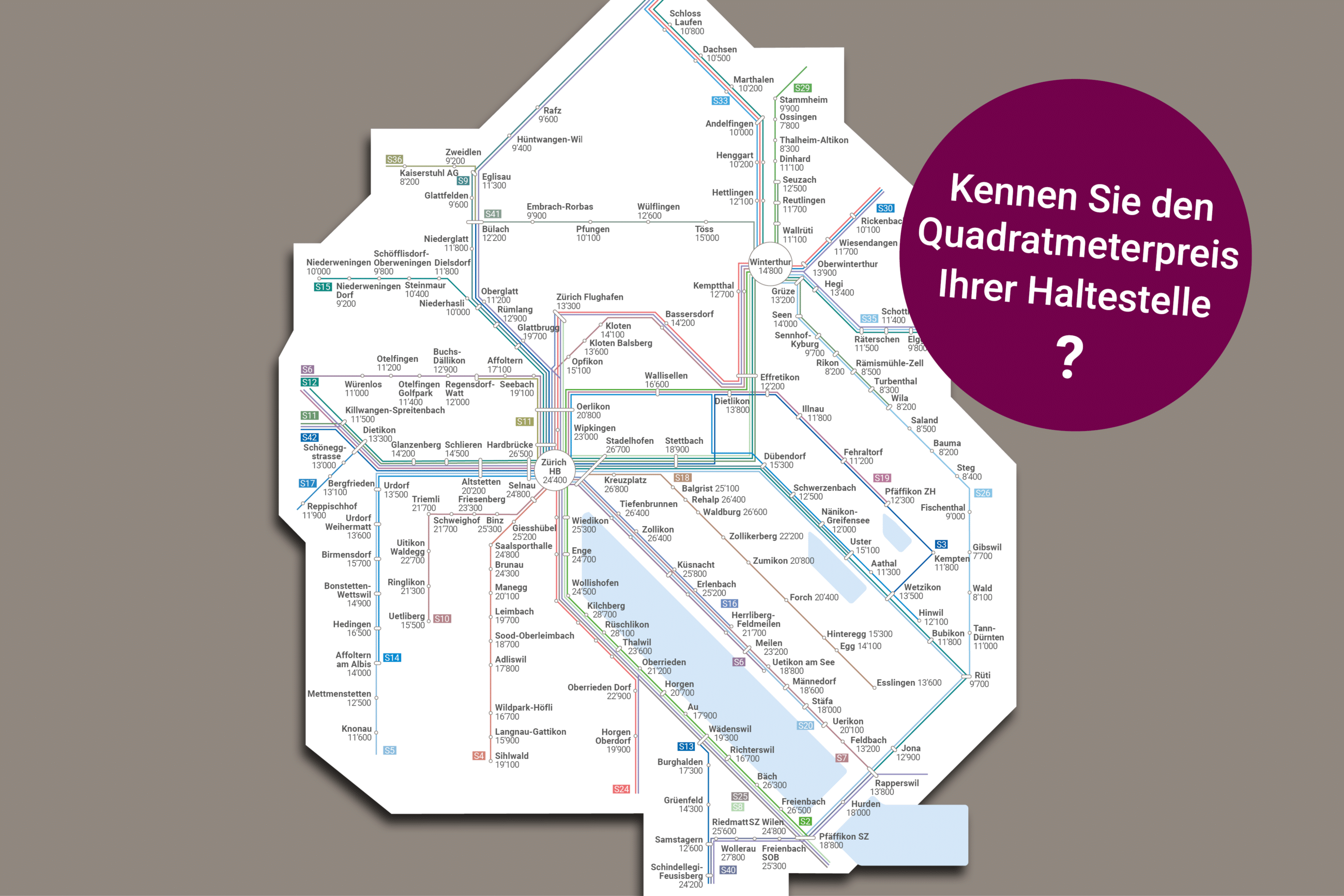
The Real Estate market is riding the S-Bahn
Reading time: 2 min

With “IN PASSING,” Claude Ginesta reveals a side of himself that few know.
Reading time: 3 min
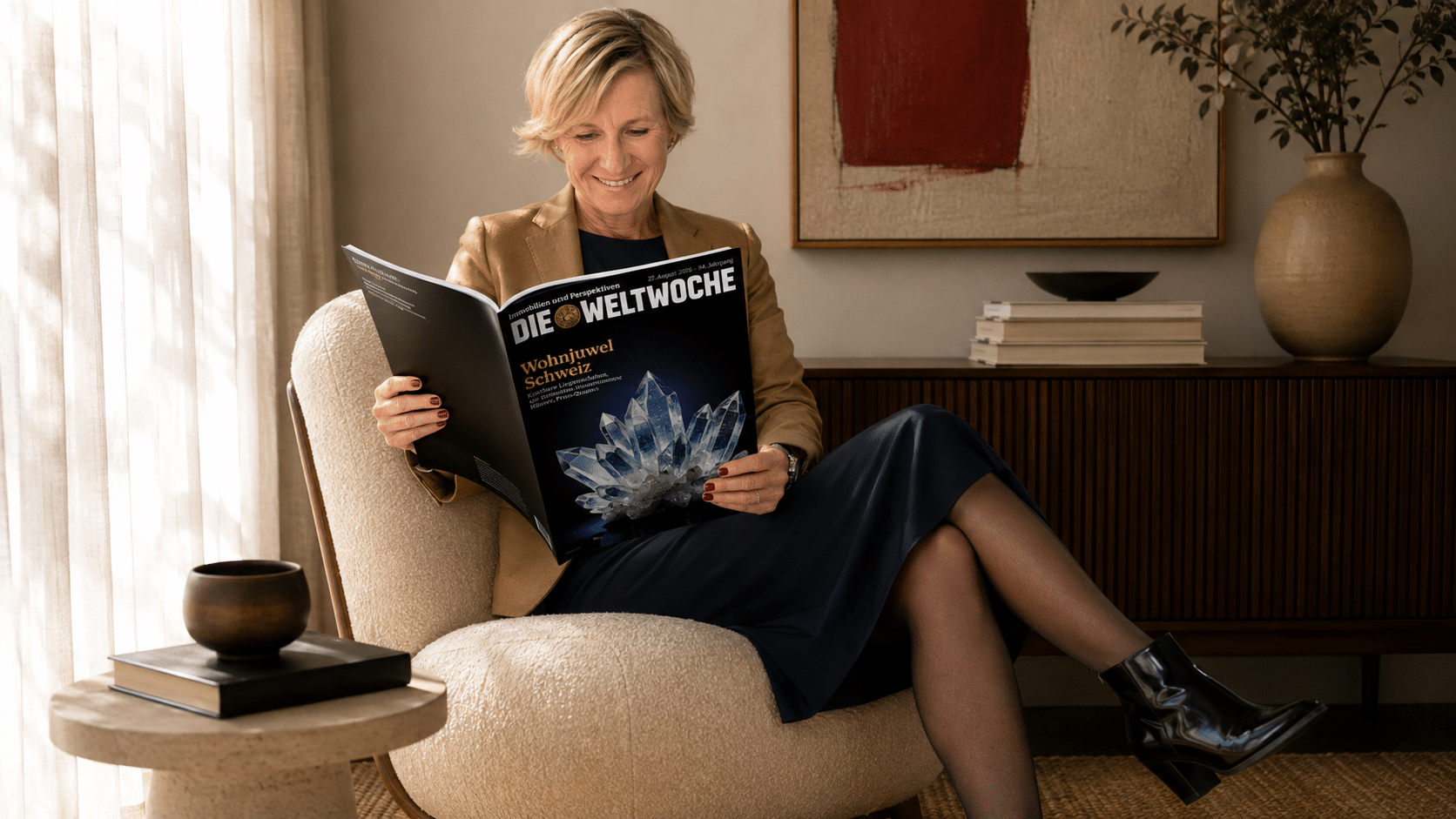
Article in *Die Weltwoche*: Interview with Katerina van der Laan, “The Swiss Are Still Very Good Buyers”
Reading time: 9 min
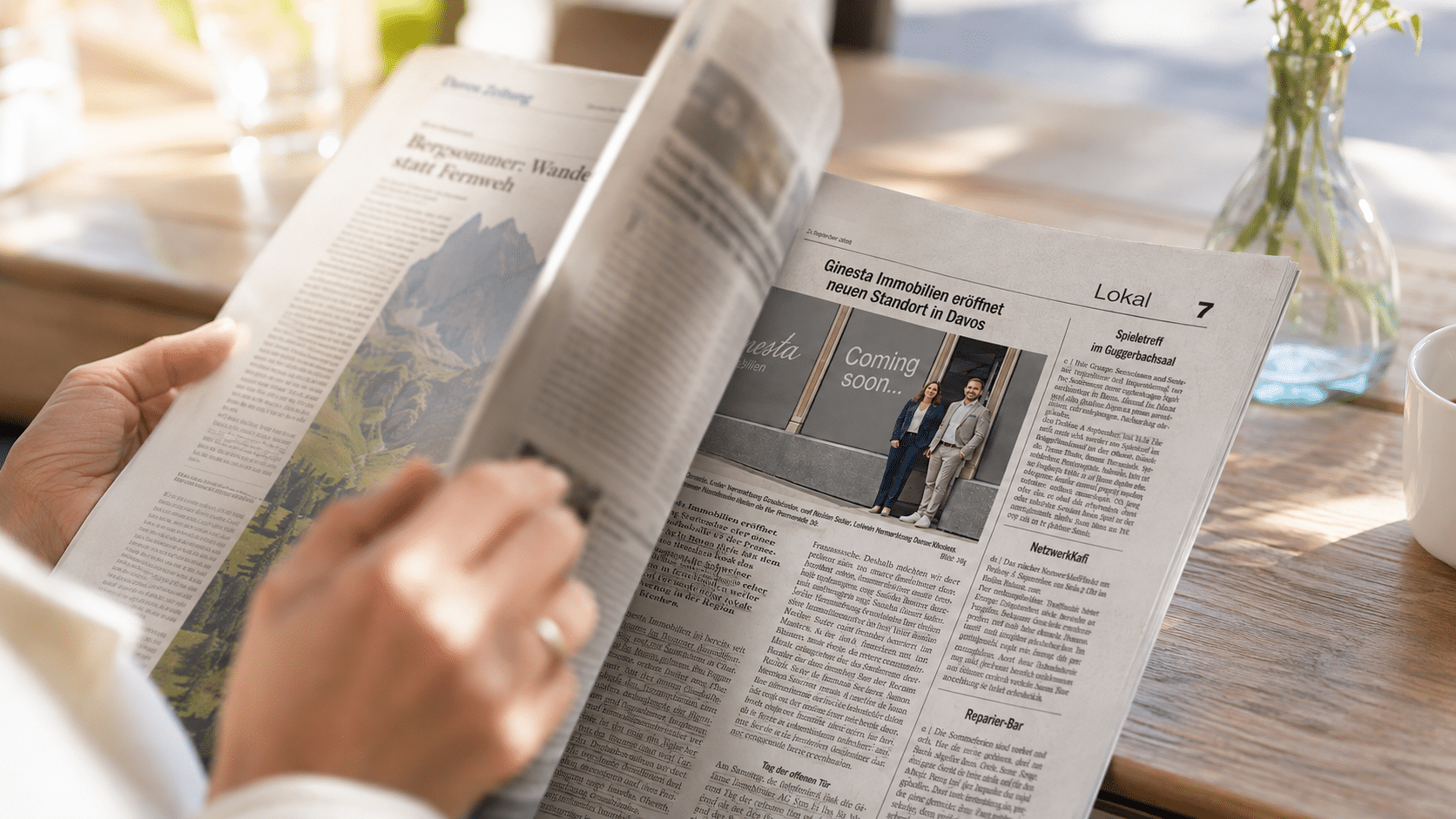
Davoser Zeitung, Sept. 1, 1926: Ginesta Opens New Office in Davos
Reading time: 2 min