Your personal search profile
Receive the real estate offers you are looking for before they are even on the market.

Rent out

Date
26.11.2020
Share
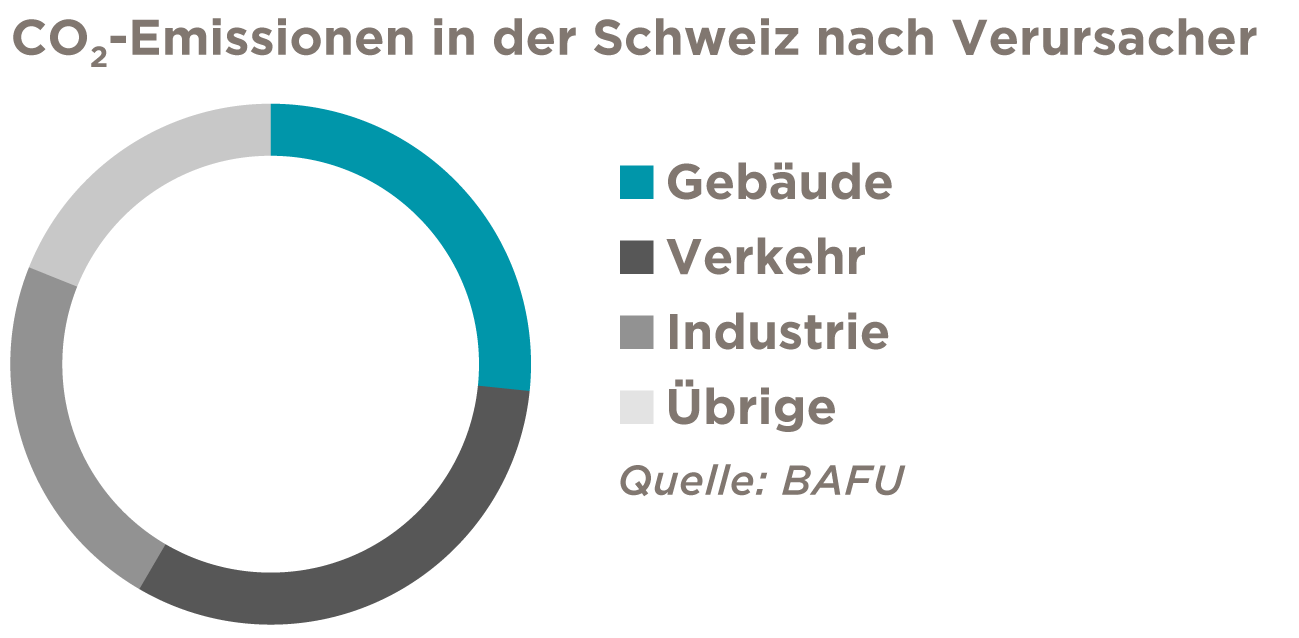
Oil and gas heating systems are primarily responsible for CO2 emissions from buildings. The other heat generators are considered CO2-neutral. This applies primarily to district heating and heat pumps. However, wood (renewable) and electricity (mainly produced CO2-neutrally in Switzerland) are also considered CO2-neutral.
As virtually no oil or gas heating systems are installed in new buildings, new buildings are CO2-neutral by definition. This makes it all the more worthwhile to take a look at those buildings that are still heated with oil or gas. Older properties are particularly problematic, as not only do they usually still use fossil fuels for heating, but in many cases they are also poorly insulated. The pressure on owners is increasing, not least because more and more cantons are implementing the MuKEn 2014.
What does this mean? Will the owners of such properties now have to invest a lot of money without any financial benefit? And will tenants have to accept higher rents in any case? A study commissioned by the Swiss Federal Office of Energy (SFOE) from Real Estate consultants Wüest Partner shows that this need not be the case.
The environment benefits in any case
There is no question that the environment benefits from energy-efficient refurbishments if a building is operated in a more environmentally friendly manner following an energy-efficient refurbishment. But what conditions must be met so that property owners and their tenants can also benefit from energy-efficient renovations?
How owners of rental apartments benefit
Property owners benefit from an energy-efficient refurbishment if they can finance the investment costs through higher rental income and thus increase the market value of their properties.
Rental income typically increases in two stages: First, according to tenancy law practice, part of the investment can be passed on to the existing tenants. This increases income in any case. In many cases, this is sufficient to compensate for the investment costs, but often it is not.
However, one should not forget the second step, which takes place as part of the usual tenant fluctuation: When re-letting, the landlord namely has the opportunity to adjust rents, which lag behind the market, especially in the case of long-term tenancies, back to the market level. As the gross rent (net rent plus ancillary costs) is decisive for tenants, the landlord can generate higher net income in future with the same gross rent due to the lower heating costs. Ultimately, this means that if the rent is increased to market level, the entire investment costs of the energy-efficient refurbishment can be passed on to the new tenants retrospectively. The additional income generated by the refurbishment therefore increases with each change of tenant. The market value effect of a refurbishment is only fully realized once all apartments have been newly occupied and rents are back at market level.
How tenants benefit
Tenants benefit from an energy-efficient refurbishment if the refurbishment reduces heating costs to such an extent that the increase in net rent is more than compensated for. The higher the heating costs were before the refurbishment, the greater the likelihood that the gross rent will be lower after the refurbishment than before the refurbishment. Not to be forgotten, of course, is the fact that tenants can not only benefit financially from refurbishment in certain cases, but also benefit from greater living comfort in all cases. For example, new windows not only have a better insulation value, but also provide better protection against noise; comfort ventilation significantly increases the quality of living; and a geothermal heat pump system not only heats in winter, but also offers the possibility of cooling the apartment in summer. In addition, more and more tenants are attaching importance to living in an environmentally friendly property.
How owners of owner-occupied residential property benefit
Owners who live in their own four walls can also benefit financially from an energy-efficient refurbishment. This is the case if the savings on heating costs are higher than the financing costs of the Renovation. Today’s low interest rate environment offers particularly favorable opportunities for this.
Under what conditions do owners and tenants benefit as well as the environment?
Heating costs: The higher the heating costs before the refurbishment, the greater the likelihood that the savings resulting from the refurbishment will exceed the financing costs.
Replacing the heating system: The easier it is to replace a fossil heating system with a non-fossil heating system, the lower the costs for replacing the heating system. This means that it is helpful if a property that is to be renovated can be connected to an existing district heating network or is in a location where a heat pump can be installed without great effort.
Depth of intervention: The most financially efficient refurbishments are often those that do not involve the maximum possible depth of intervention. Replacing an oil or gas heating system with a non-fossil heating system is usually the most important measure. Depending on the situation, this can be accompanied by other measures (new windows, insulation of the basement ceiling, roof or parts of the façade, photovoltaic system).
Subsidies: State subsidies reduce the net investment costs of refurbishments and benefit both the tenant and the owner. They often tip the scales when it comes to whether a refurbishment pays off financially for the parties involved. The amount of the subsidies and the conditions for obtaining them vary greatly from canton to canton and from municipality to municipality.
Conclusion
Energy-efficient refurbishment will not always result in three winners (environment, owner, tenant). However, the study makes it clear that the potential for this is quite large and has probably been underestimated to date.
Source
This article is based on the study “Energetic renovations. Owners, tenants and the environment as winners”, written by Wüest Partner on behalf of the Swiss Federal Office of Energy (SFOE). 

Retirement in the right home: making the dream come true
Reading time: 3 min

Martin Brüngger and his sure instinct for the investment Real Estate market
Reading time: 5 min
Imputed rental value to be abolished: Why older properties can become a sales risk as a result
Reading time: 5 min

The three Zurich housing initiatives: an initial classification
Reading time: 11 min
We inform you about suitable properties before they are publicly offered.
"*" indicates required fields
One of the many advantages
I already have an account. To the login
"*" indicates required fields
"*" indicates required fields