Your personal search profile
Receive the real estate offers you are looking for before they are even on the market.

Rent out

Date
3.5.2022
Share
On 11. On March 1, 2012, the Swiss electorate approved the popular initiative “An end to the unbridled construction of second homes” and thus decided to severely restrict the construction of second homes. The initiative demanded that the proportion of second homes in a municipality should not exceed 20 percent. An ordinance published at the beginning of 2013 was valid until the implementing legislation for the second homes initiative came into force and provided clarity in the market. Since the 1. The Federal Act on Second Homes (Second Homes Act, ZWG) came into force on January 1, 2016 and regulates the future construction of second homes. The affected municipalities, i.e. localities with a proportion of second homes of more than 20 percent, include practically all tourist regions in the cantons of Bern, Graubünden, Ticino, Vaud and Valais.
Transitional provisions lead to construction boom
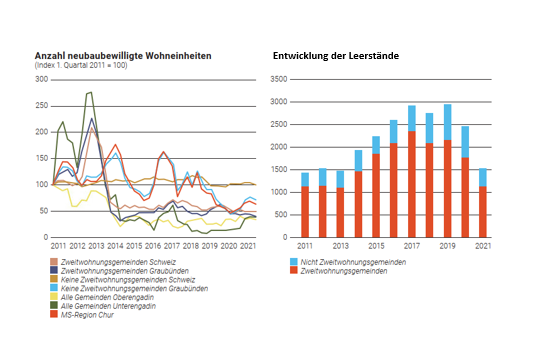
Until 31.12.2012, second homes could still be approved under the old law, which led to a marked increase in building applications between March and December 2012 and triggered a veritable construction boom. In theory, construction should have started on all approved buildings within twelve months (with a one-off extension of 24 months). However, as exemptions were introduced in many municipalities, new construction activity remained at a good level for years afterwards. At the same time, it is still possible under the new regulation to expand the offer under certain conditions. These include a) existing buildings with secondary dwelling areas can be subdivided or extended by up to 30% (extension or subdivision is permitted), b) tourist apartments, c) apartments in structured accommodation establishments, d) Dwellings in protected buildings or buildings that are characteristic of the locality.
Supply surplus turned into supply shortage
The balance between supply and demand became unbalanced due to the construction boom from 2012 to 2017. At the same time, a heterogeneous development was observed because the absorption capacity of the various submarkets diverged. While there was a clear transition in the Davos/Klosters region and the Engadin, the effects in Arosa and Lenzerheide, but also in Flims-Laax, were far less pronounced. This was partly due to the fact that in certain regions larger projects with more residential units were built, whereas in other places smaller apartment buildings tended to be realized. In addition, the EUR/CHF exchange rate came under further strong pressure in 2014/15, which also had an impact on the real estate market in top locations such as St. Moritz and Klosters. Other regions that were less dependent on Europe’s economic development benefited from an above-average proportion of Swiss guests and from new and attractive tourist offers. After 2015, hardly any new buildings came onto the market, which led to a continuous reduction in supply. Since 2018, we have seen a decline in vacancy rates and a renewed upward trend in prices. Financing second homes is very attractive due to the interest rate situation – it is better to invest your equity in a vacation home than to pay negative interest rates at the bank.
Benefiting from the significant increase in demand during the Covid pandemic, supply quotas in all tourism regions have fallen significantly and are now lower than ever before. In many places, there are hardly any apartments or houses left to buy.
When it comes to Real Estate, prospective buyers are looking for good accessibility, a suitable infrastructure and an intact landscape.
Prices remain high and continue to rise
Single-family homes in attractive mountain communities are and will remain in high demand. As a result, top prices are being achieved for this property category in many places, and these prices are now at all-time highs. The situation is similar for rare luxury properties, which continue to see high demand. In the vacation home sector—that is, the classic second home—price trends varied by region until the onset of the COVID-19 pandemic in 2020. However, now that a shortage of supply has set in in many areas, prices are rising steadily and at a comparable rate in percentage terms. The lack of supply has also significantly reduced the time it takes to sell a property. It is worth noting that it was not only the Second Home Initiative per se that was decisive for price trends, but also the attractiveness of a municipality, which is based on many microfactors. As a result, Lenzerheide has emerged in recent years as the second-most expensive vacation region in Graubünden after St. Moritz (see the Arosa-Lenzerheide section).
Economic situation in Europe changes guest mix
The proportion of foreign buyers in the mountains has been declining for several years. Potential buyers from Europe in particular have been confronted with several negative factors since 2011. On the one hand, the euro crisis and the associated appreciation of the Swiss franc, and on the other, the economic weakness in Italy and France as well as new tax conditions abroad. Overall, the vacation markets compensated for these negative factors and the associated appreciation of foreign competitor destinations such as Austria through increased domestic demand.
Managed second homes/parahotel industry complements offer
Tourist apartments are partially exempt from the restriction clause. This category includes, in particular, properties that are not individually tailored to the personal needs of the owner and that are offered for short-term rental as part of a structured accommodation business. A Federal Supreme Court ruling in 2019 clarified that a spatial proximity between the accommodation business and the property offered for rent is a prerequisite for a uniform operation. A management contract with a hotel alone is not enough. The market for managed second homes with a rental obligation was previously small and in some regions non-existent. The travel behavior of “Generation X” and “millennials” is different from that of traditional vacation home buyers and is likely to favor this temporary form of accommodation. Furthermore, the shortage of supply of second homes under the old law has brought managed apartments into the focus of buyers and we are now seeing demand for such products at top destinations. It is still too early to assess the development of prices and demand on the established vacation apartment market, but we do see a positive trend for such offers, provided they are attractively designed. And the following still applies: the top priority is the positioning and touristic attractiveness of a region, in all segments.
Conclusion: vacation apartments remain en vogue – despite, or perhaps because of, the second home initiative
Since the adoption of the second homes initiative, the vacation homes market has offered the desired clarity and legal certainty. When talking about the second-home market, each vacation region must be considered individually. Nevertheless, the demand for second homes in tourist destinations will remain a general need. Today, prospective buyers are looking for good accessibility, infrastructure and offers that meet their needs and an intact landscape. However, factors such as the general economic situation, the level of prosperity, the level of interest rates and refinancing and the psychological expectations for the future should not be underestimated and are almost more important. The vacation property is a luxury object and is only indulged in if the surroundings allow it.
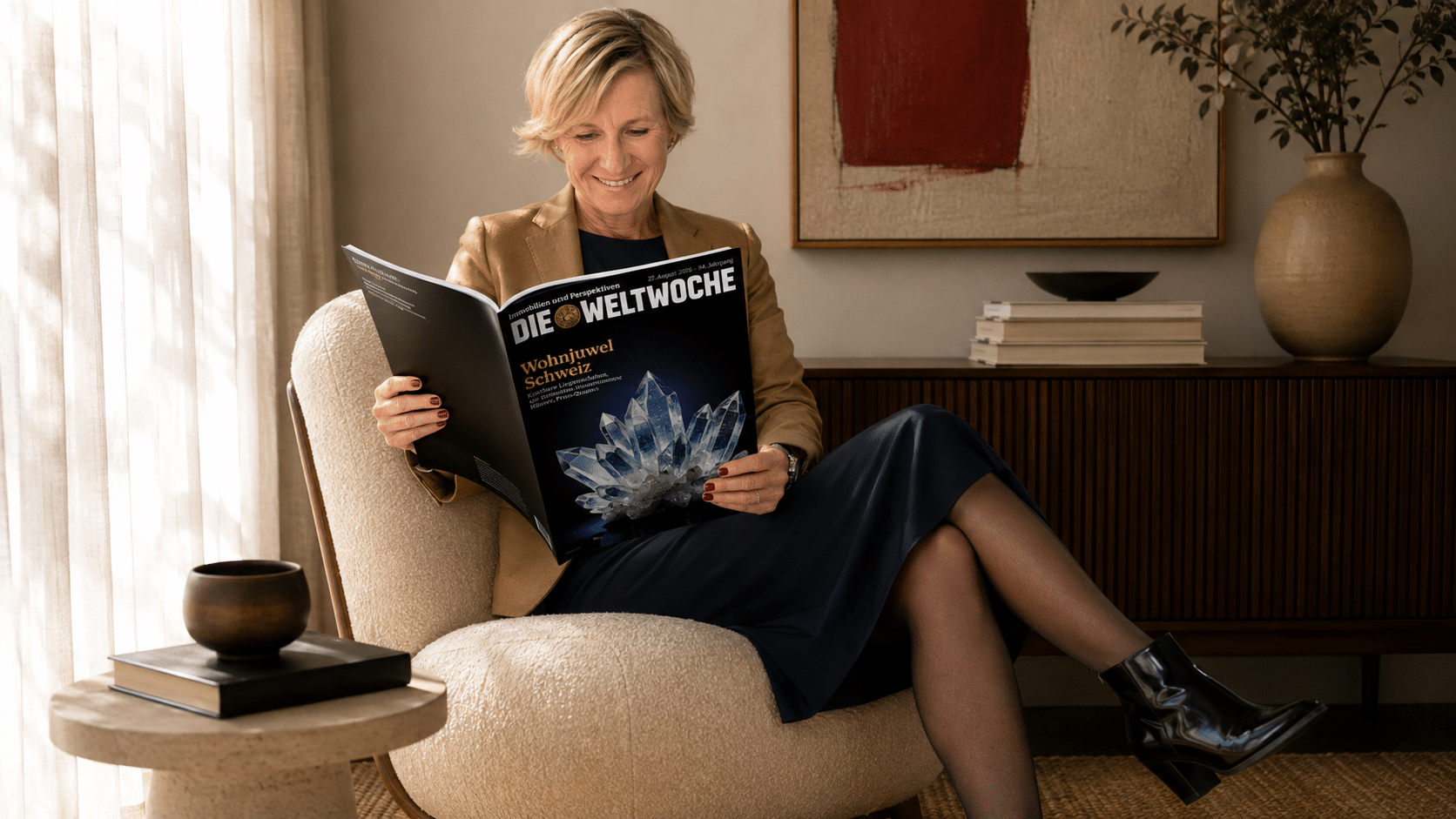
Article in *Die Weltwoche*: Interview with Katerina van der Laan, “The Swiss Are Still Very Good Buyers”
Reading time: 9 min

Davoser Zeitung, Sept. 1, 1926: Ginesta Opens New Office in Davos
Reading time: 2 min

Wellbeing@Work: Ginesta Launches New Program for Employees
Reading time: 5 min

Nadine Suter will become the site manager of Ginesta’s new location in Davos
Reading time: 6 min