Your personal search profile
Receive the real estate offers you are looking for before they are even on the market.

Rent out
Date
17.3.2022
Share
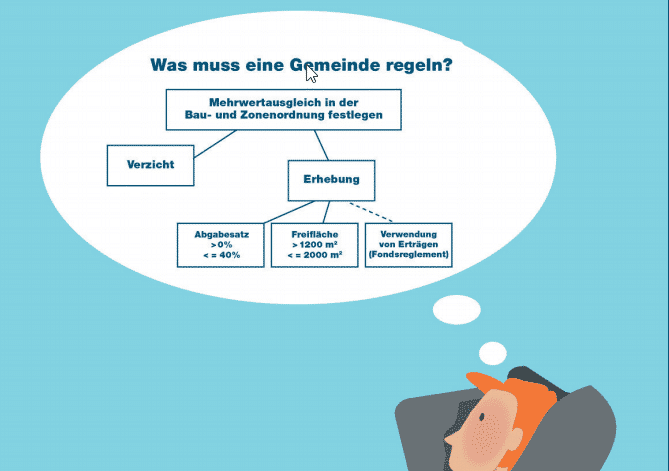
Anyone dealing with this topic cannot avoid the terms MAG and MAV. These are the two sets of regulations that have recently come into effect. The MAG is the cantonal law on added-value compensation, which stipulates that, in the case of rezoning, 20% of the added value is payable as a levy at the municipal level. The MAV, the Value-Added Compensation Ordinance, regulates value-added compensation at the municipal level for rezoning and upzoning. This must be specified by the municipality in its building code (BZO) and approved by the canton. This value-added compensation may not exceed 40%. This is a substantial sum which, as might be expected, will be fully utilized by the City of Zurich, for example. If a municipality chooses not to apply the value-added levy, this must also be specified in the BZO by March 1, 2025, at the latest. In any case, a vote must be held on any amendment to the BZO; the corresponding municipal proposals will be put to a public vote in the coming years.
If you would like to take a closer look at this process, we recommend this explanatory video from the Canton of Zurich Building Department, which explains the complexity of the topic well, or the PDF at the end of this article:
The purpose of this article is merely to point out the direction of travel and to draw attention to the fact that a levy is being introduced here that will lead to significant difficulties in the construction of new living space, that will be passed on to tenants and buyers for obvious economic reasons and that will place high technical and time-related demands on the canton and municipalities. And one that can be effectively countered with the right decision at the ballot box.
Cantonal officials use a computer-based platform to determine the added value with a value-added forecast. A hedonic method in which individual adjustments can be made by the officials. The landowners can subsequently comment on this proposal. If the municipality, which is responsible for determining the added value, and the owner do not agree, a time-consuming procedure begins, which is fraught with high costs and legal hot air. The landowner can then request an appraisal from a pool of appraisers compiled by the canton, which he will pay for at his own expense. In each individual case, the appraiser is determined exclusively by the canton and the further process is then up to the municipalities. If there is still disagreement, the only option is to take legal action. And since there are still many uncertainties and all the boundaries still have to be explored in practice, the courts will have a lot of work to do. A development that must also be observed with a keen eye and which, in terms of trickiness and potential pitfalls, is similar to the difficulties of determining property gains tax, which is also regulated at municipal level and therefore often differently from municipality to municipality.
“Anyone who wants to prevent the value-added equalization from making urgently needed housing in the canton of Zurich significantly more expensive will have the opportunity to do so at the ballot box.”
The value-added compensation “earned” by the municipalities is transferred to a fund to finance spatial planning measures. This finances planning law measures through to expropriations and measures for the design of public spaces, which is of course irrelevant in terms of the origin of the money. This means that the money paid indirectly into this fund by builders of residential or commercial space can be used to design parks, green spaces or to create social infrastructure such as meeting places for young people or senior citizens or extracurricular facilities.
This cross-financing unnecessarily increases the construction costs of urgently needed space and a pass-through to rental and purchase prices is clearly to be expected. The final opportunity to minimize or prevent these levies now lies with the individual municipalities, which can waive them. All that remains is for each and every individual to get involved at local level and to take a close look at the specific compensations provided for in the respective proposals when voting on them.
PDF of the Building Directorate
” Value-added compensation explained in brief”

Article in *Die Weltwoche*: Interview with Katerina van der Laan, “The Swiss Are Still Very Good Buyers”
Reading time: 9 min

Davoser Zeitung, Sept. 1, 1926: Ginesta Opens New Office in Davos
Reading time: 2 min

Wellbeing@Work: Ginesta Launches New Program for Employees
Reading time: 5 min

Nadine Suter will become the site manager of Ginesta’s new location in Davos
Reading time: 6 min