Your personal search profile
Receive the real estate offers you are looking for before they are even on the market.

Rent out
Date
6.4.2017
Share
The building and zoning plan revision was approved by the electorate of the Canton of Zurich in 1995. This revision abolished single-family home zones throughout the canton of Zurich. Due to the much higher utilization possibilities, more and more single-family houses are now being demolished and replaced by multi-family houses. This was previously unthinkable in selected (country house) zones. Various municipalities have changed their calculations from living space dimensions to building dimensions, which has led to increased land use possibilities.
Real estate prices on both shores of Lake Zurich have exploded in the last five years. There are hardly any offers, demand far exceeds supply. Has spatial planning failed?
Voices from the left and green camp are becoming louder, calling for further densification. The same exponents reject urban sprawl, i.e. the creation of new residential areas in current reserve zones. Individual groups are even demanding that new zoning for purely single-family residential areas be ruled out in principle. Architectural models should also be developed for the densification of inner building land reserves, e.g. existing single-family home neighborhoods. In fiscal terms, these landscape conservationists demand that undeveloped plots in the middle of the settlement area should be encumbered. Even the acquisition of densification plots by the public sector is desired.
Incidentally, the settlement area in Switzerland as a whole is just under 7%, while the agricultural area is 37%. In the canton of Zurich, however, around 20.1 % of the cantonal area was already designated as settlement areas in 1996.
Municipalities with a liberal background around Lake Zurich have completely different goals. They want to protect private residential property. The municipality of Zollikon put it in a nutshell in its application for zoning in 2005: according to the current BZO, Zollikon is only 2/3 overbuilt, so on average each plot would still have the possibility of building 1/3 more. Nevertheless, the building boom would lead to problems: “In a number of neighborhoods, the complete consumption of the permitted utilization would lead to an unpleasant and undesirable townscape”. Unfortunately, the municipal assembly did not approve the application for zoning, in contrast to the municipality of Küsnacht, which approved zoning in some municipal areas in 2004. An arms race has long since begun in Zollikon, as in other municipalities: Even higher, even wider! The consequences for property owners are fatal, everyone’s view is obstructed, the neighbor is getting closer and closer, privacy suffers.
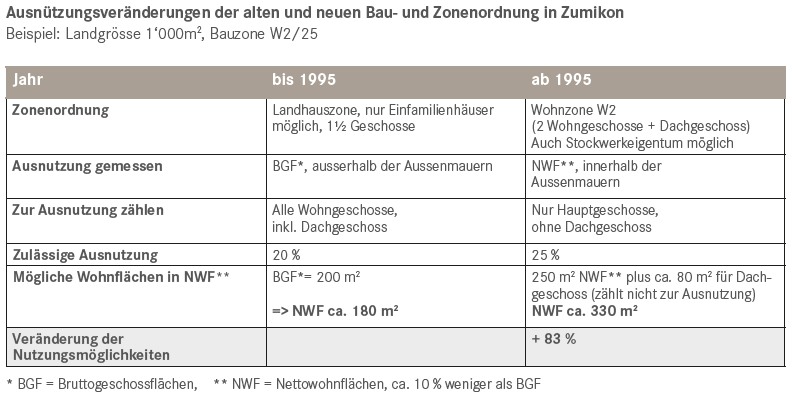
The properties with the greatest privacy are probably to be found in Zumikon, where large residential areas are still in a less utilizable zone W2/25 with large boundary distances of 2 x 12m (for comparison: many municipalities only have 6 or 7m boundary distances in residential zones). In Zumikon, the expensive residences and estates are still protected from intrusive neighboring buildings. How much longer remains to be seen. In the context of densification, Zumikon will soon be asking itself whether it will be possible to keep building so restrictive in the future. The civic-dominated municipal council will certainly examine this question with the necessary caution. After all, the possibilities for use have already been significantly increased in this municipality since 1995, as the example here shows.
Developments in spatial planning remain exciting and are becoming a political plaything between liberal and socialist ideas. Densification tendencies are unmistakable, from political parties, from architects (interesting architecture) and from the construction industry (order potential).
It is important to decide how many inhabitants a region should be built for and which spatial planning measures make sense and are desired/supported by the citizens. Densification through high-rise districts in insensitive locations can certainly be discussed, but the destruction of green, well-kept residential areas demanded by individual exponents must be questioned very critically and is unlikely to meet with the approval of the population.
The further increase in immigration and/or an increase in the level of prosperity will lead to greater spatial requirements in the Zurich region. This inevitably raises the question of whether to develop in width (urban sprawl, new zoning of building land reserves) or in height (densification). Both options have advantages and disadvantages, which are weighted differently depending on the observer and their interests. In any case, the spatial planning decisions will have an impact on further price developments in the hot spots of the Lake Zurich municipalities.
Author: Claude Ginesta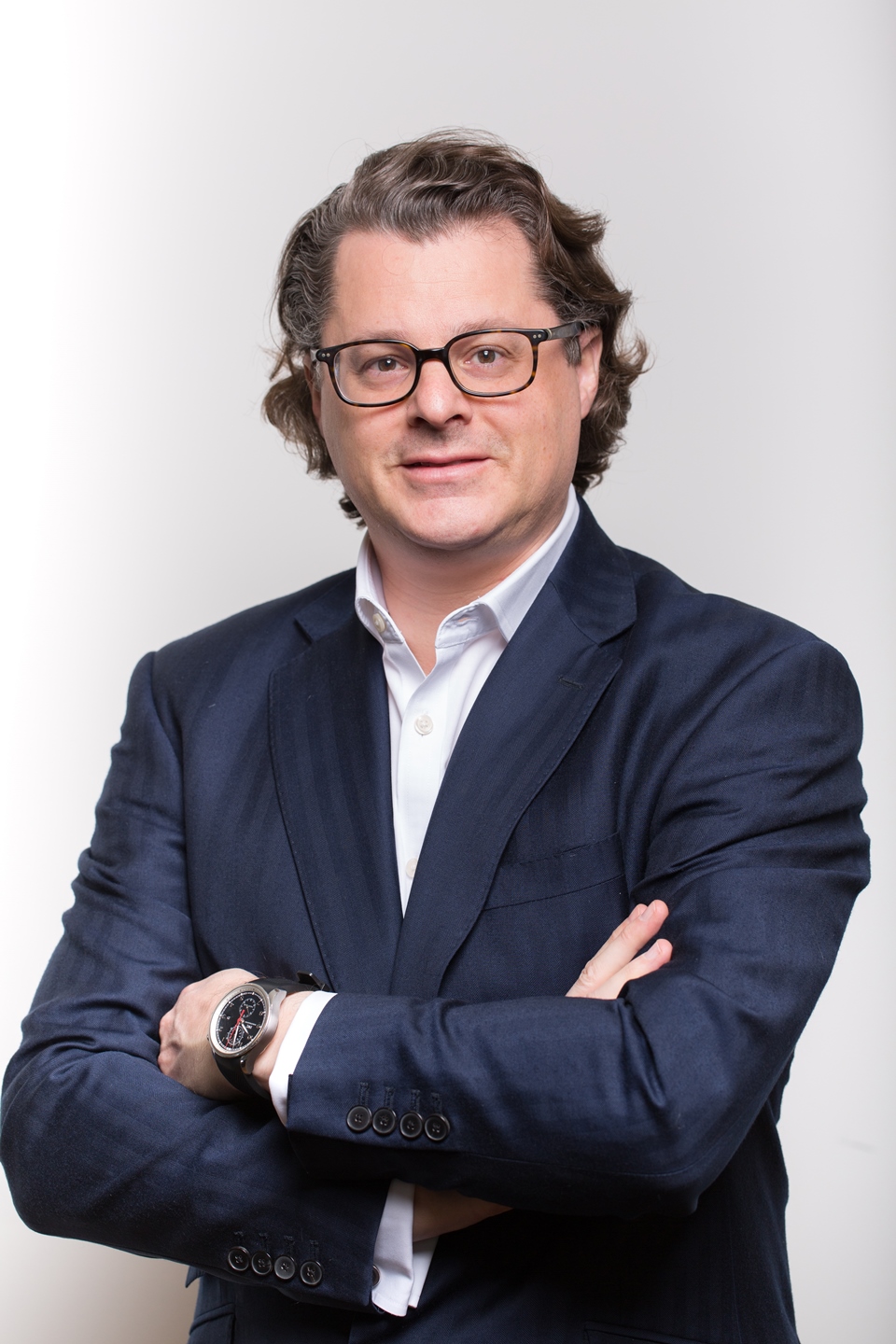
Claude A. Ginesta is a Swiss certified real estate trustee and CEO / owner of Ginesta Immobilien AG. The company was founded in 1944 and specializes in the sale of real estate in the economic area of Zurich and Graubünden. With branches in Küsnacht, Horgen and Chur, the company acts as an estate agent throughout Switzerland for properties with a supra-regional character.
Publisher of the Illusions series: Ginesta Immobilien AG, www.ginesta.ch

Why it is crucial to know the current value of your property in 2026
Reading time: 3 min
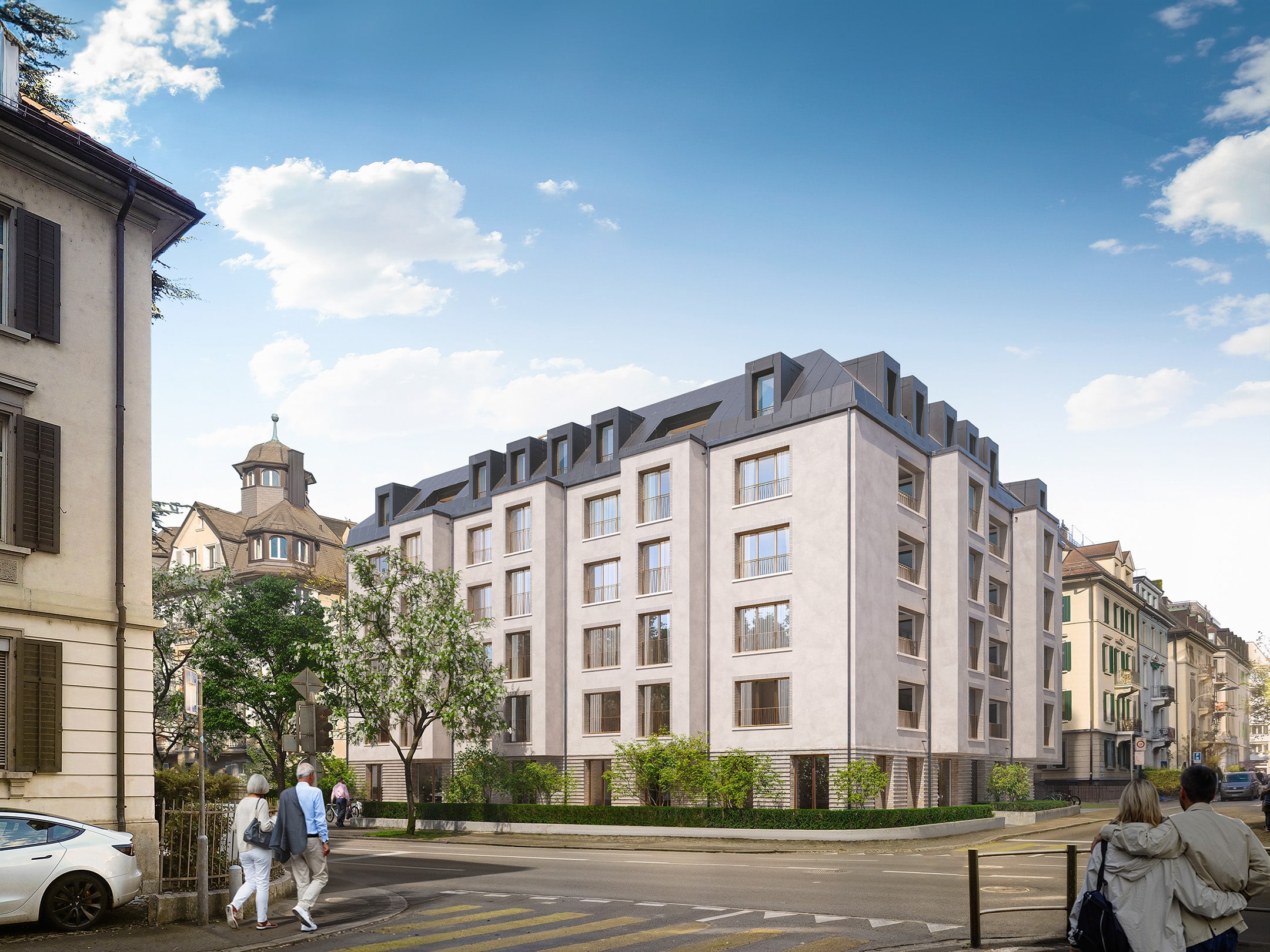
New-build rental apartments and tiny houses in Zurich Seefeld
Reading time: 2 min

A good estate agent pays off when selling real estate
Reading time: 3 min

When the house gets too big
Reading time: 3 min
We inform you about suitable properties before they are publicly offered.
"*" indicates required fields
One of the many advantages
I already have an account. To the login
"*" indicates required fields
"*" indicates required fields