Your personal search profile

Receive the real estate offers you are looking for before they are even on the market.

Moderne Küche mit Holzregalen und Kochutensilien

Would you like to sell your real estate?

Our team will accompany you personally. From the valuation to handing over the keys

Moderne Wohnung mit offener Wohnküche und Balkon in urbaner Umgebung

Would you like to rent out your property?

Get in touch with us, we will be happy to advise you professionally and without obligation.

Get in touch with us

We will be happy to advise you personally and professionally.

Modernes Stadthaus zum Kauf am Zürichberg mit Blick auf die Stadt Zürich

Would you like to have your property valued?

Discover our professional real estate valuation and advice

Your direct line to us.

Have we aroused your interest? We look forward to hearing from you.

Illusion No. 10: Property sales can be carried out without a notary …

... if you want to rely on the handshake of the good old days. However, you can read here how to do this much more securely and professionally.
illusion nr 10 titel

Date

18.3.2017

Author

gin001-s

Share

The notarial profession in general

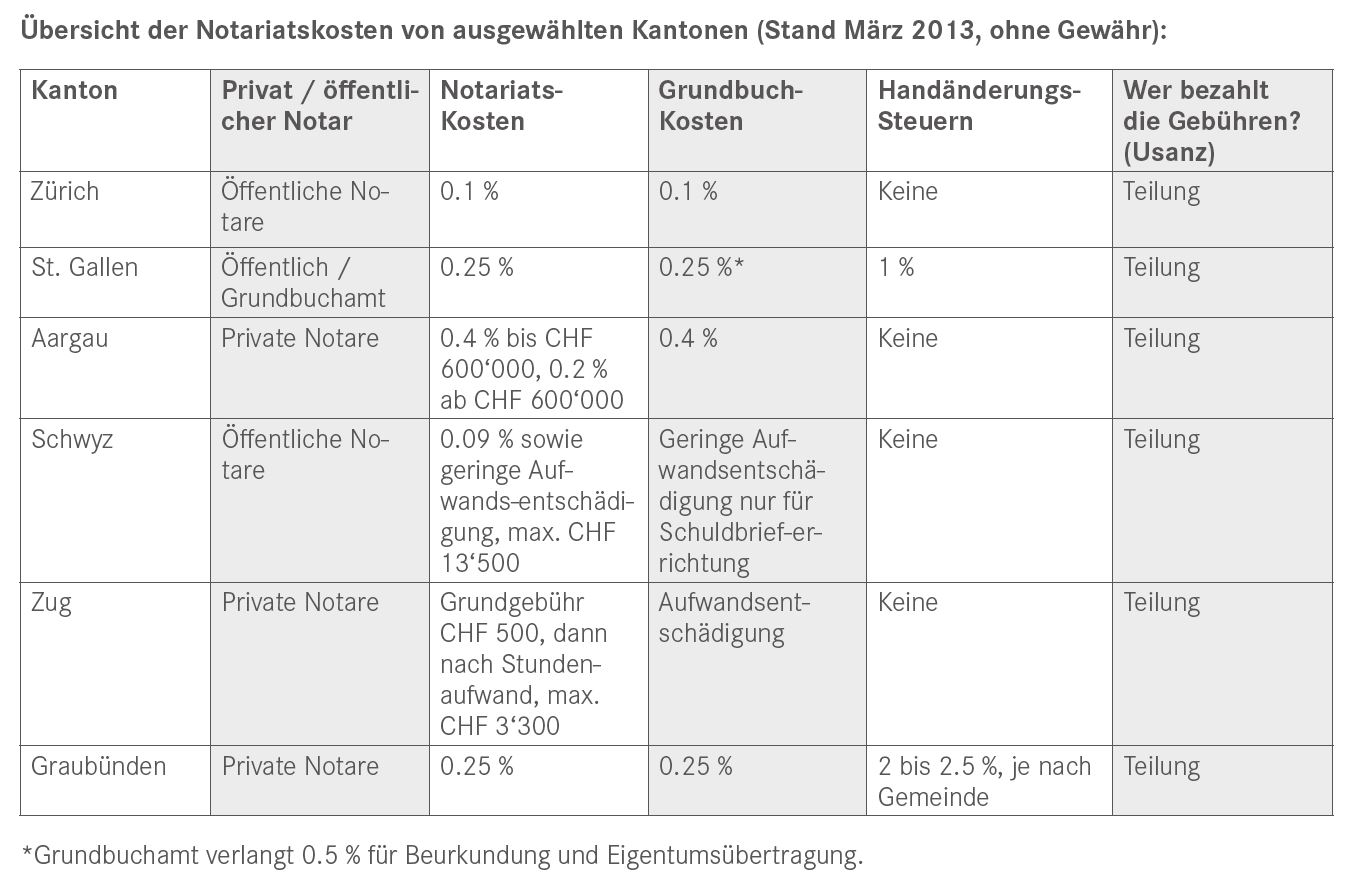
In Switzerland, only notarized contracts are binding for buyers and sellers. This form is also known as “qualified notarization”. In some cantons, notaries work on a freelance basis, in others they are civil servants. With private notaries, you have the freedom to choose your own notary. In the case of public notaries, you must contact the notary’s office of the respective municipality. Usually 2-3 municipalities are served together in one notary’s circle. Public notaries are usually somewhat cheaper, while private notaries may be more willing to provide a higher level of service (due to competition). Depending on the canton, the buyer or seller pays the notary’s fees. In many cantons, these are shared.

Notarization of the purchase contract and transfer of ownership

The purchase act is divided into two phases. These can take place simultaneously or directly one after the other, or they can be delayed according to a fixed schedule.

1. the commitment transaction = signing of the purchase contract

This is the signing of the purchase agreement. The buyer and seller sign the purchase contract in the presence of the notary, which regulates the entire legal transaction. The buyer undertakes to pay the purchase price and the seller undertakes to transfer ownership to the buyer.

2. the fulfillment transaction = transfer of ownership

Ownership is only transferred upon completion of the transaction. The buyer is entered in the land register as the new owner against payment of the purchase price. The transfer of ownership can take place immediately after the contract is signed or within a certain period of time (agreed in the purchase contract). With public notaries, it is usual for the notary to also deal with the land register transaction at the same time. Private notaries contact the land registry, which is always state-run, for the execution transaction.
illusion nr 10

Content of a purchase agreement

The purchase agreement essentially regulates the following points:

1. naming the contracting parties (buyer / seller)
In order to check the personal details, the notary will request a passport or identity card at the notarization appointment.

2. the property description
The property is shown here according to the land register. The buyer must accept this content. He must understand the content and significance of easements, notes and reservations. He must also be informed about existing mortgage notes. In some cantons, the notary even reads out the property description or the entire contract.

3. the purchase price repayment
This section describes how high the purchase price was agreed and how the payments are to be made. In the past, the purchase price was paid in cash or by check; today, property purchases are always made with irrevocable promises to pay from Swiss financial institutions.

4. the further provisions
This section is the most extensive. With the exception of a few points, contractual formal freedoms apply; in practice, the further provisions in purchase agreements often look the same or very similar. The notary would like to have the following points regulated in the further provisions:

a. Date of transfer of ownership
b. Date of transfer of possession (transfer of benefits and risks)
c. Settlement of the ongoing costs associated with the contractual object
d. Legal warranty for material defects / provision of guarantees
e. Regulation of the bearing of costs for notary and land registry fees
f. Arrangement/security of property gains tax and any transfer taxes
g. Transfer of existing insurance contracts
h. Transfer of any rental agreements
i. Entry into contracts and resolutions (especially in the case of apartments such as management contracts, renewal funds, resolutions of the condominium owners’ meeting)
j. References to legal provisions regarding retention rights and arbitration clauses (for apartments)
k. Information on restrictions on ownership under public law and the law on the inspection of low-voltage installations
l. Clauses for foreigners (purchase permits)
m. Clauses concerning matrimonial property regime and family home (for special matrimonial property regimes such as community of property, declaration of consent when selling a family home)

Procedure for the purchase of land

  • A reservation contract can take precedence over a purchase contract, especially for new buildings, but also for existing properties. The reservation contract is not legally binding unless it has the content of the main contract and is publicly notarized. In most cases, the reservation contract is equivalent to a “gentlemen’s” agreement. The seller undertakes to remove the property from the market and not to show it to any other prospective buyers. In return, the buyer undertakes to pay a reservation fee and to sign the purchase contract within a specified period. If the reservation contract is terminated, the deposit must be repaid in accordance with the current practice of the Federal Supreme Court. However, the seller may deduct verifiable costs (e.g. notary’s fees and travel expenses).
     
  • If the buyer and seller agree on the essential points of a property sale, the draft contract can be sent to the notary’s office or the notary can be asked to draw up such a draft. In the case of a reservation contract, it is advisable to specify the main points of the contract, such as the purchase price, transfer date and other ancillary conditions.
     
  • It usually takes at least 5-10 working days to get an appointment for the notarization at the notary’s office. This time may be shorter with private notaries. Once you have agreed on all contractual points, you go to the notary and notarize the purchase contract.
     
  • A transfer of ownership with the transfer of benefits and risks can take place following notarization or at a fixed, later date. It should be noted that in cantons with private notaries, they are not responsible for the land register. In Zurich it is a personal union, in other cantons such as Graubünden or Aargau the notary must bring the contract to the land registry for registration.

CHECKLIST / DOCUMENTS REQUIRED FOR NOTARIZATION!

Irrevocable promise to pay
It is customary to request a down payment on the purchase price at the time of notarization. The financing institution (bank or insurance company, possibly pension fund) must also often provide the seller with an irrevocable promise to pay the down payment and possibly the remaining purchase price at the time of notarization. Checks and cash payments have long been a thing of the past. Today, real estate sales are practically always settled by irrevocable promises to pay.

Certificate of legal capacity
In some cantons (not in the canton of Zurich), a certificate of legal capacity is required from the buyer. This must be requested from the residents’ registration office in the municipality and proves that the buyer has the capacity to act. Buyers from abroad cannot provide this certificate, and some cantons do not require it.

Identity card or passport and foreigner’s identity card
All contracting parties require a passport or identity card to identify themselves. Foreigners also require a foreigner’s identity card B or C. In the case of vacation homes, further permits (e.g. for 2nd homes) or a certificate of residence may be required for primary residences.

1. INVENTORY

The following documents must be brought to the notarization appointment:

Buyer / Acquiring party

  • Identity card*
  • For foreigners: Foreigner’s identity card / residence permit B or C
  • Original of the irrevocable promise to pay from the bank or insurance company to the seller’s bank

Seller / Selling party

  • Identity card*
  • All privately concluded insurance policies (e.g. building water, building liability, etc.) in copy in advance for information purposes
  • Copy of rental agreement (if rented)
  • Management contract in copy
  • Notification of low-voltage installation tests, if carried out within the last 5 years

2. TRANSFER OF OWNERSHIP

The following documents must be brought to the transfer of ownership appointment:

Buyer / Acquiring party

  • Identity card*
  • Foreigner’s permit / residence permit B or C
  • Any irrevocable promises to pay, if not already given at the time of notarization

Seller / Selling party

  • Identity card*
  • All existing, privately concluded insurance policies in the original
  • Original rental agreements
  • Existing floor plans (originals)
  • Warranty certificates and operating instructions for machines and installations
  • All keys to the property, existing locking plan

For apartments

  • Copy of existing management contract
  • All existing management documents (accounts, minutes, resolutions of recent years) * If applicable, a notarized power of attorney in the event of any representation

* If applicable, a notarized power of attorney in the event of representation.

Important information on the transfer of ownership:

In the event of any debt certificate increase, the original debt certificates must be submitted to the notary’s office upon transfer of ownership!

The selling party is requested to carry out the following transactions as of the date of transfer of ownership (transfer of possession):

  • Commission utilities to read electricity, gas, water and wastewater meters
  • Reading the heating oil level and calculating the heating oil stock if necessary
  • inform service contract partners (e.g. heating companies) about the sale
  • Final settlement to be drawn up in favor of / at the expense of the acquiring party
  • Heating oil stock can be charged at cost price (last purchase price)
  • Insurance premiums paid in advance in January for the whole year from the cantonal buildings insurance can be settled pro rata temporis (the state insurance does not reimburse these premiums)
  • Any other invoices that were paid in advance, such as basic waste disposal fees (available in some municipalities)
  • In the case of rented properties, the rents received are settled pro rata temporis on the day of commencement
  • In the case of apartments, the quarterly or semester invoice (management account) paid in advance or still to be paid can be offset pro rata temporis (the management does not prepare interim financial statements)
  • Inform the post office about the move and have mail redirected for at least 1 year
  • Still to be considered for apartments: Inform administration about change of ownership

PDF Illusion No. 10

Author: Claude Ginesta
claude ginesta 2628ab

Claude A. Ginesta is a Swiss certified real estate trustee and CEO / owner of Ginesta Immobilien AG. The company was founded in 1944 and specializes in the sale of real estate in the economic area of Zurich and Graubünden. With branches in Küsnacht, Horgen and Chur, the company acts as an estate agent throughout Switzerland for properties with a supra-regional character.

Publisher of the Illusions series: Ginesta Immobilien AG, www.ginesta.ch

More about the topics
Share

More property knowledge

iStock 1220666866 scaled

Current legal change: More protection for home buyers in the event of construction defects

Reading time: 4 min

Learn more
eigentuemerportal ginesta bewirtschaftung

Ginesta owner portal: transparency for your property

Reading time: 2 min

Learn more
DSC08089 2 scaled

When the vacations begin for others, our team is running at full speed.

Reading time: 3 min

Learn more
Winterhilfe

Ginesta supports Winterhilfe Switzerland

Reading time: 1 min

Learn more

Ginesta Real Estate Newsletter

Become part of our community and receive exclusive real estate offers, up-to-date real estate knowledge and our news directly in your mailbox.

Request sales brochure

This field is for validation purposes and should be left unchanged.
This field is hidden when viewing the form

Create your personal search profile

We inform you about suitable properties before they are publicly offered.

Jetzt Kontakt aufnehmen

"*" indicates required fields

This field is for validation purposes and should be left unchanged.
This field is hidden when viewing the form

Anmelden oder registrieren

One of the many advantages

  • Access to virtual tours & exact addresses
  • Find your dream property in a targeted manner
  • Prioritized notification of new property listings

I already have an account. To the login

Your message to me

Direct message to the respective location, not to an individual

"*" indicates required fields

This field is for validation purposes and should be left unchanged.
This field is hidden when viewing the form

Your message to us

Direct message to the respective location, not to an individual person

This field is for validation purposes and should be left unchanged.
This field is hidden when viewing the form

Jetzt Kontakt aufnehmen

"*" indicates required fields

This field is for validation purposes and should be left unchanged.
This field is hidden when viewing the form