Your personal search profile
Receive the real estate offers you are looking for before they are even on the market.
Rent out
Date
6.4.2017
Share
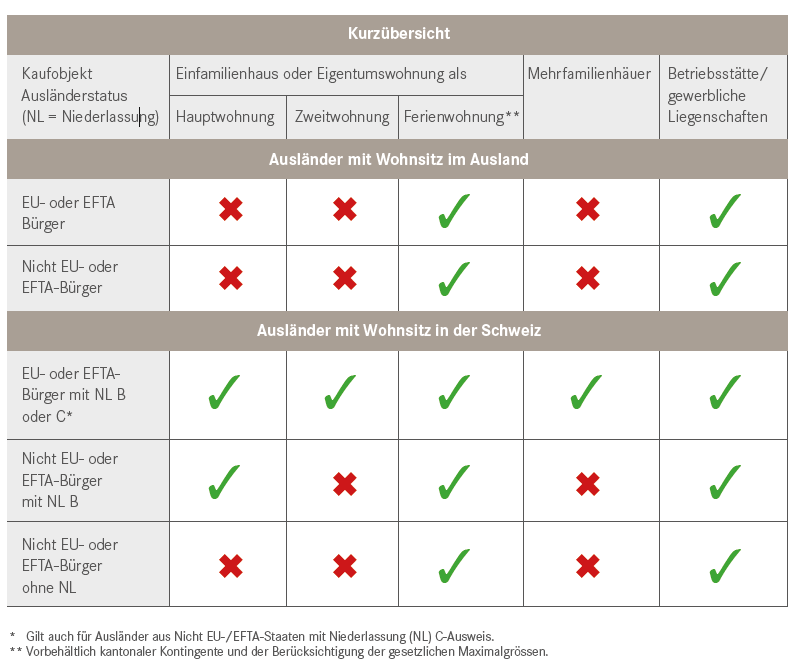
A protective hand can still be felt over the Swiss Real Estate market. The Lex Koller is a special law that only a few countries have. Foreign buyers are not always aware that land cannot simply be bought in Switzerland. The law was originally introduced in 1961 as protection against foreign infiltration, but has been relaxed several times in recent years. Statistics collected since 1967 show that up to 1993 only 0.8 % of zoned building land was sold to foreigners. However, the significance of second homes and vacation homes is much greater, as around 1/5 of this area was in foreign hands in 1993. In many cases, foreigners can buy real estate in Switzerland today despite the Lex Koller. Below is an overview of the most important exceptions and possibilities for acquiring property in Switzerland despite the Lex Koller:
Since October 1, 1997, the purchase of commercial real estate in Switzerland has been permitted. Properties used for economic purposes are considered commercial. These are therefore referred to as “business premises,” such as manufacturing facilities, warehouses, office spaces, shopping centers, retail stores, hotels, restaurants, workshops, or medical practices.
In the case of commercial real estate, it does not matter whether the property is used by the purchaser or rented or leased to third parties. For foreigners seeking an investment opportunity, this is the simplest form of investment and the easiest way to acquire real estate in Switzerland. However, the purchase becomes problematic if the property is used for residential purposes in addition to its commercial purpose. Only in exceptional cases may residential units be acquired as part of a business premises without a permit. One such exception is when the residential use is deemed necessary for business operations. Another exception applies to commercial properties with officially mandated residential quotas (maximum 49% residential use). A further exception applies when separating the residential areas from the commercially used portion is practically impossible and would be disproportionate.
It may therefore be necessary to obtain a declaratory ruling from the cantonal licensing authority.
In some cantons, it is possible to purchase vacation properties. These are not subject to the Lex Koller, provided that the floor area is less than 1,000 m2 and the net living space is less than 200 m2. Net living space includes all habitable rooms such as bedrooms, kitchen, hallway, bathroom, toilet, enclosed swimming pool, sauna, hobby room, but not balconies, stairwells, cellars and attics. In accordance with current practice, net living areas of up to 250 m2 and land areas of up to 1,500 m2 are approved without any major problems if an additional requirement is proven, and in exceptional cases, even larger amounts exceeding these standard limits are approved.
The following cantons have vacation rental quotas: Appenzell Ausserrhoden, Bern, Fribourg, Glarus, Graubünden, Jura, Lucerne, Neuchâtel, Nidwalden, Obwalden, St. Gallen, Schaffhausen (only for accommodation units in apartment hotels), Schwyz, Ticino, Uri, Vaud and Valais.
All cantons must also observe the quotas set by the federal government. In Switzerland, only 1,500 vacation homes may be sold annually to foreigners who are not resident in Switzerland. The number varies greatly from canton to canton. The canton of Valais currently has the highest quota with 330 residential units, while various smaller cantons such as Appenzell Ausserroden, Uri, Nidwalden, Glarus, Obwalden, Jura and Schaffhausen only have 20 units. When purchasing a non-residential vacation home, a buyer must be included in this quota or wait to be included. The municipalities have also created quotas for the percentage of foreigners in an apartment building. Depending on the municipality, these further restrict the purchase options for foreigners who are not resident in Switzerland.
In principle, any foreign national with a valid B or C residence permit may purchase a primary residence for their own use. “For their own use” means that both their legal residence and tax domicile will be transferred to the municipality where the property is located. All foreign nationals may take advantage of this option to purchase a primary residence. At the time of purchase, they must prove that they hold a residence permit and that their actual residence will be located in the purchased property. Properties with land areas exceeding 3,000 m² also require a special permit. In such cases, the question of the “unity of the property being purchased” is of particular importance. Citizens from the EU or EFTA region have enjoyed even greater privileges since the bilateral agreements with the EU came into force. Once they have established residence in Switzerland (in conjunction with a C residence permit), they may purchase private and commercial real estate without restriction. They may also purchase multi-family homes and second homes for their own use. As a result, these individuals are generally treated the same as Swiss citizens and are not considered “persons abroad” within the meaning of the Swiss Real Estate Transfer Tax Act (BewG). This change also allows them to purchase real estate through companies that they control and that are domiciled in Switzerland.
The purchase of shares in a listed real estate company does not require a permit and is not subject to the Lex Koller. However, the real estate company must be listed on an official stock exchange in Switzerland. These are regulated by the Swiss Financial Market Supervisory Authority (FINMA). The purchase of shares in a non-listed residential real estate company is more problematic. A residential real estate company is an unlisted company whose actual purpose is to acquire or hold residential real estate or other non-residential real estate. A distinction is made here as to whether
The individual cases:
In the case of real estate companies with commercial and residential properties, the main purpose of the company must be determined by the authorities. As soon as the share of residential property accounts for more than one third of a company, there may be a violation of Lex Koller or BewG.
Excerpt from the current Wikipedia entry
Lex Koller is the informal name of the Swiss “Federal Act of December 16, 1983 on the Acquisition of Real Estate by Persons Abroad” (BewG, SR 211.412.41). The name of the law goes back to the former Federal Councillor Arnold Koller, who was a member of the National Council when the law was drafted. The purpose of the Lex Koller is to combat the “over-foreignization of domestic land”. It contains a restriction on the acquisition of Swiss real estate by foreigners and replaced the Lex Friedrich, itself the successor to the Lex Furgler. The Lex von Moos and Lex Celio were similar enactments in the 1960s/70s. There are currently discussions about abolishing the Lex Koller and allowing foreigners to acquire properties in Switzerland without a complicated authorization procedure. The reason for these discussions is, on the one hand, the bilateral agreements with the European Union and, on the other, pressure from cantons particularly interested in liberalized regulations for tax reasons, for example. Liberalization would strongly favour the construction of second homes with so-called cold beds.
References / disclaimer:
The information has been compiled from current laws and publications. The author expressly points out that individual text passages have been taken from the source text and do not originate from him. In order to improve readability, footnotes and source references have been omitted from the texts.
Fact sheet of the Federal Office of Justice
Acquisition of real estate by persons abroad (available in four languages)
Ordinance on the Acquisition of Real Estate by Persons Abroad
(BewV) of October 1, 1984 (as of January 1, 2008)
Federal Law on the Acquisition of Real Estate by Persons Abroad
(BewG) of December 16, 1983 (as of January 1, 2011)
Parliament has been debating the abolition of the Lex Koller for some time. In return, spatial planning restrictions are planned, particularly in the area of second homes, which would affect both Swiss and foreign residents. The National Council has rejected the Federal Council’s proposals with the request to examine the following three points when drafting a new bill:
Supporters of the Lex Koller want to curb the influx of foreigners into Switzerland and the purchase of luxury real estate by foreigners who do not take up residence in Switzerland, while opponents advocate for further liberalization. We Swiss can purchase residential properties almost anywhere in the world—so why shouldn’t foreigners be granted the same right here?
Ginesta Immobilien does not take a political stance and is guided by political circumstances. At the same time, we are of the opinion that the previous discussions on abolition at federal level were not sufficiently understandable for voters. The Federal Council wanted to abolish the Lex Koller at federal level, but wanted to give the communes and cantons instruments to virtually replace it at communal level with spatial planning measures. These intentions and their effects are still unclear. They need to be carefully weighed up – provided that their effects are known to voters one day. We can therefore understand Parliament’s hesitant stance and welcome the further examination of the planned legislative amendment.
Author: Claude Ginesta

Article in *Die Weltwoche*: Interview with Katerina van der Laan, “The Swiss Are Still Very Good Buyers”
Reading time: 9 min

Davoser Zeitung, Sept. 1, 1926: Ginesta Opens New Office in Davos
Reading time: 2 min

Wellbeing@Work: Ginesta Launches New Program for Employees
Reading time: 5 min

Nadine Suter will become the site manager of Ginesta’s new location in Davos
Reading time: 6 min