Your personal search profile
Receive the real estate offers you are looking for before they are even on the market.

Rent out
Date
6.4.2017
Share
Financing in general
When assessing home financing, Swiss credit institutions check the customer’s creditworthiness and the quality of the property. The financing structure and affordability analysis play an important role.
The loan against residential property is normally 80% (risk) capital. Therefore, a homeowner must normally contribute at least 20% of the purchase price in the form of equity or deposit it as security. This can be available to the homeowner in the form of savings capital, securities, entitlements or pension fund assets, among other things. In the case of very high incomes, the equity can be mortgaged instead of being offset against the purchase price. In such a constellation, the mortgages can easily reach 90-100% of the purchase price.
However, a classic financing structure is usually used, whereby the financing institution hypothecates 80% of the purchase price, usually divided into a first mortgage (65%) and a second mortgage (15%). The homeowner contributes the remaining 20% of the purchase price with their own equity. Unlike in other European countries, mortgages in Switzerland do not have to be repaid in full. Normally, the second mortgage is repaid by means of direct or indirect amortization until retirement age, but in 20 to 25 years at the latest. In contrast, the 1st mortgage often remains in place beyond retirement age.
Affordability also plays an important role, both at the start of financing and at retirement age. The affordability calculation measures the level of housing costs (mortgage interest, amortization and ancillary maintenance costs) in relation to income. Depending on the financing provider, a maximum limit of around one third of gross or net income is set. Some institutions set the limit at 28% of net income, while others finance home ownership at housing costs of up to 33% of gross income. This different assessment of affordability can be equivalent to an income difference of around 10%.
Luxury and collector’s properties (from CHF 2.0 million)
Financing luxury properties differs considerably from traditional financing. It is worth taking a closer look at the special guidelines and lending principles of credit institutions (banks and insurance companies):
The assessment criteria vary depending on the credit institution. In general, the following property characteristics speak in favor of the assessment as a luxury property:
It goes without saying that the property location is the most important criterion when assessing an exclusive property. In locations with expensive land prices (e.g. Geneva-Coligny, Lausanne-Ouchy, Meggen, Zürichberg, Zurich Gold Coast, March region in the canton of Schwyz, Zug, Gstaad or St. Moritz), construction is often more elaborate and more expensive. The total price (land costs and construction costs) is certainly decisive, but varies greatly depending on the region.
The “Liebhaberobjekte“
Some credit institutions have created an additional category, the “Liebhaberobjekte”, which are financed according to special principles. A collector’s property is a special residential property that is unusual and may have the following characteristics:
The market values of collector’s items are often not calculable. For example, a costly Renovation of a farmhouse often costs much more than a new build. For the lending institution, the market value assessment is often a matter of judgment, as traditional market value assessments (e.g. using comparative value or hedonic models) do not produce correct results.
The following explanations show the differences:
The changed financing structure:
Luxury and collector’s properties are less highly mortgaged. The owner must contribute at least 35 % to 40 % of the mortgage value in the form of equity to the financing. The first mortgage only covers around 50 % of the property value, the second mortgage often only another 10-15 %. In most cases, the 2nd mortgage must be amortized by the time you retire, and in many cases even part of the 1st mortgage. This reduces the proportion of debt financing to 50% of the property value or even lower.
The changed affordability calculation:
Owners of exclusive properties often have high incomes and sufficient equity. The high mortgage value is often due to tax considerations. In addition, the unused cash can be invested in assets or used in a company. The affordability calculation can also show more than 33% of the gross salary if the income and asset situation is good. Depending on the income situation, it is not uncommon for housing costs to account for 35-40% of total income when financing luxury properties.
The changed banking relationships
Financing is often assessed by banks taking into account the entire customer relationship. Other business areas that the customer maintains with the bank (e.g. investments, insurance, business relationships) are taken into consideration. In the case of financing, the customer must assume that he will be assessed by the credit institution as a whole and that “counter-transactions” are required for good, favorable conditions.
The changed interest rate conditions
Owners of luxury properties are usually rated as AAA customers and enjoy good credit conditions thanks to their creditworthiness and the often high mortgage amount. Depending on the situation (loan-to-value ratio, income situation, other customer relationships), a customer margin of 0.6 % to 0.8 % on the respective refinancing rate (money or capital market rates) can be expected. Normally, customer margins for traditional financing are around 1.0 % to 1.3 %, which is significantly higher.
In summary, it can be stated that the financing of luxury properties and collector’s items should be viewed in a very differentiated manner.
Author: Claude Ginesta
Claude A. Ginesta is a Swiss-certified Real Estate trustee and CEO/owner of Ginesta Immobilien AG.
The company was founded in 1944 and specializes in real estate sales in the Zurich and Graubünden regions. For properties of supraregional significance, the company operates as a real estate broker throughout Switzerland via its branches in Küsnacht, Horgen, and Chur.
Publisher of the Illusions series Ginesta Immobilien AG, www.ginesta.ch
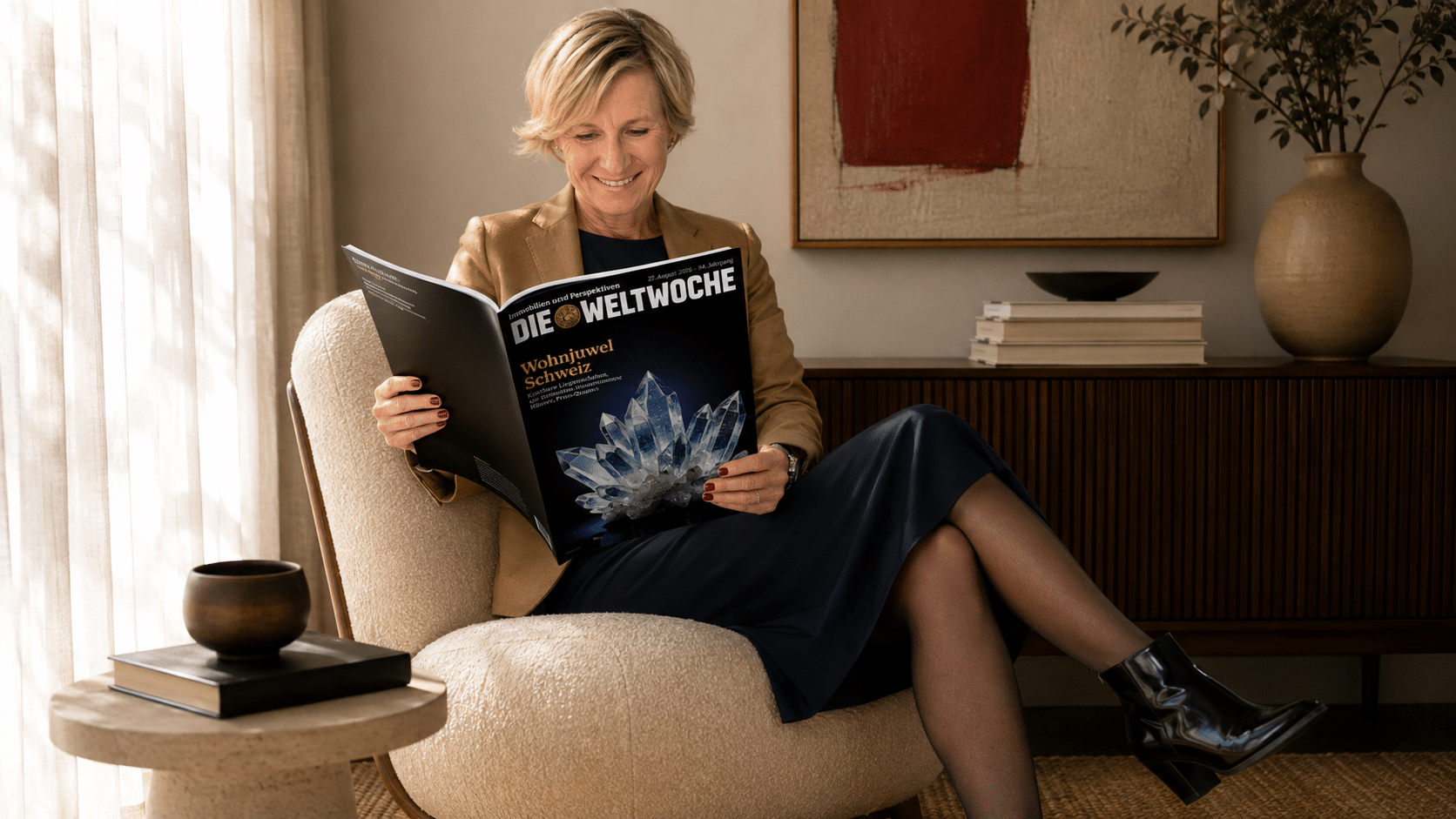
Article in *Die Weltwoche*: Interview with Katerina van der Laan, “The Swiss Are Still Very Good Buyers”
Reading time: 9 min

Davoser Zeitung, Sept. 1, 1926: Ginesta Opens New Office in Davos
Reading time: 2 min

Wellbeing@Work: Ginesta Launches New Program for Employees
Reading time: 5 min

Nadine Suter will become the site manager of Ginesta’s new location in Davos
Reading time: 6 min